Friday, April 30, 2010

Pecked to Death

I have a hard time imagining a critic I'd disagree with more than Dale Peck.  In fact, it's hard to imagine anyone agreeing with Dale Peck with any degree of consistency.  In his essay collection Hatchet Jobs: Writings on Contemporary Fiction, Dale Peck just hates so much: "most of Joyce, half of Faulkner and Nabokov, nearly all of Gaddis, Pynchon, Delillo, not to mention... their contemporary heirs," a category that includes David Foster Wallace, Colson Whitehead, Jamaica Kincaid, and, of course, Rick Moody.  But that's not all.  Peck, like a small, aggressive child who has just learned the meaning of the word "no," emphasizes his renunciation of these authors over any subtler points he might have to make about their work -- and, like a small, aggressive child, he is more intent on kicking you out of his blanket fort than persuading you to come around to his point of view.  Regarding Pynchon, Peck writes that "the US literary world can be divided into two camps: those who think Pynchon is a very clever guy, and those who think he's a great writer... I'm of the former camp."  Of Rick Moody's work he declares, "My gut feeling is that if you honestly don't believe it's bad, you're part of the problem."  And Vonnegut's old-age slump is the fault of his fans: "It's not the Vonnegut's fans don't believe what he has to say.  They just don't seem to care." 

Peck is not just controversial.  He's profoundly unconvincing.  It's possible to write a negative review, even a diatribe, yet seem as though you're having a good time.  The seduction of negative reviews, in fact, is that derision sometimes seems more entertaining than sincere enjoyment: over there at the grown-ups' table they're laughing harder at the clown.  Yet Dale Peck, like Patton Oswalt's unfortunate heckler, seems doomed to "miss everything cool and die angry."  The writers he reviews not only appear to be having more fun than Peck is; they also, surprisingly, even sound like they have a better sense of humor (and this is based on Peck's descriptions alone).  Peck's bon mots are the province of an unseasoned stand-up comic, veering from da-doom-crash punchlines ("As we say in the East Village, that and $2.50 -- not including tip -- will buy you a skinny mochaccino" and "with friends like this, literature needs an enema") to clumsy attempts at harnessing catchphrases ("As a friend of mine says, That is just so wrong").  Dale Peck seems to not quite get the jokes of the books he reads.  He's quick to take offense, to jump to conclusions, to take things literally.  Even A Confederacy of Dunces comes under his ire ("a book nearly as bloated as its protagonist"), which I find ironic, since if Ignatius Reilly were a book reviewer, he would write a lot like this.

Peck is a master of the unintentionally funny.  His rage, like that of a cartoon character, sends him wheeling off cliffs, tiny fists pummeling the air, or yanking on the fuse of a bomb that winds up detonating in his hands.  Many of the funniest moments here are hilarious not because he's right or wrong, but because of what he inadvertently reveals about himself.  In the Rick Moody essay, he writes, "When I finished The Black Veil I scrawled 'Lies! Lies! All lies!' on the cover and considered my job done."  Let's unpack this statement for a moment.  There are two possibilities here.  Either Dale Peck defaced his own hardcover copy of the memoir (reminiscent of the US patriots who dumped French wine they had already purchased down toilets in the early, heady "freedom fries" days of the second Iraq war) -- in order to, I guess, prove a point to anyone who noticed it proudly displayed in his home?... or Dale Peck is pretending that he did just that in order to, I guess -- sound punk rock?

His persona is larger than life, and larger than any of the points he makes.

And yet, despite all this, I find it impossible to dismiss Dale Peck's Hatchet Jobs, if only because of the weird humility that underlies the entire project.  In the Afterword, he writes, "The very extremity of my views does as much to undermine my authority as enforce it, or at least I hope it does, because I am by no means convinced of the hallowedness of my own ideas... These reviews, if not as direct as a barroom brawl, are, I hope, some kind of dialogue with my generation... My hatred of all this teenaged posing has reached such a fever pitch I'm willing to be clownish in my denunciation of it."  The fact that Dale Peck is willing to embarrass himself for the sake of literature, the fact that he's willing to sacrifice his own intellectual credibility "to start some kind of dialogue," is a strangely noble thing, even if it is itself a kind of adolescent posturing.

Tuesday, April 27, 2010

For Kids of All Ages, pt. 2: High Water Everywhere

"If a kid asks where rain comes from, I think a cute thing to tell him is 'God is crying.' And if he asks why God is crying, another cute thing to tell him is 'Probably because of something you did.'" -- Jack Handey, Deep Thoughts

Let's be honest: children are narcissists. They cry when they don't get their way. They throw temper tantrums. They pout. They shriek on the subway, they bawl on the bus, and god forbid you get seated next to one on an airplane. For a child, it's almost impossible to understand that his own emotional state (sorrow over a lost toy, excitement over a trip to the zoo, righteous indignation over a broken promise) is not permeating the atmosphere and affecting everyone he encounters. Conversely, when it rains on the day of a picnic, or refuses to snow come Christmastime, or when the weather outside takes another, darker turn, children turn inward; they use magical thinking to figure these indifferent external events into a personal narrative: God is angry with me, Santa knows what I did. The journey to maturity is, in part, a growing understanding that other people have their own inner lives, as intense and complex and consuming as one's own -- and that the things that happen in the world do not only happen to you.

In my last post, I talked about the genre of the Young Adult novel, and how for me that differs from a novel that's simply about young people (i.e., a bildungsroman or "coming-of-age"). I think that the central distinguishing factor between the YA and coming-of-age novels is that, in the coming-of-age novel, the child's narcissism at some point collides meaningfully with a world inhabited by others. And I don't mean a wise old baba who pops up in every few chapters to deliver homespun wisdom, or the bully at school who serves as an inexplicable thunderbolt of in-scene tension, or the Good Teacher who sees the narrator's potential. I mean other real characters, ones with motivations and drives and faults that have nothing to do with the journey our hero is on -- ones who could just as easily be the focus of a novel of their own. For just one example, in Marilynne Robinson's Housekeeping, three characters (sisters Ruth and Lucille and their aunt Sylvie) tug in opposing directions: what each one wants is understandable, but mutually exclusive to the desires of the others. In negotiating her relationships with her aunt and sister, Ruth, for all her dreamy self-absorption, is forced to enter a realm where other people's loneliness, grief, and obsessions share equal time with her own.

For all its strengths, and there are many, Extremely Loud and Incredibly Close does not share this quality, not ever but especially not at the end. And I'm going to sound the SPOILER ALERT right now, because much of what I have to say about the book relates to that ending, a ridiculous, saccharine, cop-out of a twist, which I found to be an M. Night Shyamalan-level betrayal of everything genuinely poignant or intriguing about the book that preceded it.

The set-up of Foer's novel is ingeniously simple. Oskar Schell, a nine-year-old Manhattanite, loses his father in the WTC attacks on September 11. In his grief, he discovers a key in his father's closet inside a small envelope with the word "Black" written on it in red ink. Since his father always set challenges for him, Oskar decides in mournful desperation this is one last mystery for him to solve. He sets out to find the lock that matches the key by visiting everyone with the last name of "Black" in the NY metro area. With an unlimited supply of cab fare and a shell-shocked mother who barely seems to notice his comings and goings, he embarks on a quest that takes him to all five boroughs (though, with typical New Yorker chauvinism, never to Jersey).

To me, the brilliance of this concept is that it inherently suggests a gap between the child's point of view and the harshness of reality. Oskar behaves as though he's living in The Mixed-Up Files of Mrs. Basil E. Frankweiler, but the New York he actually inhabits isn't cute or charming: it's dangerous, a place where terrorists fly airplanes out of a clear blue sky and fucking kill everyone. This reality, telegraphed from the first chapter on, inflects Oskar's imaginings with a kind of manic optimism, a naivete that feels more longed-for than actual: "Sometimes I think it would be weird if there were a skyscraper that moved up and down while its elevator stayed in place... that could be extremely useful, because if you're on the ninety-fifth floor and a plane hits below you, the building could take you to the ground," he observes on the third page. Oskar is not just a child, but a child clinging on to childhood, a precarious situation that sets us up with an immediate source of tension. As he rings the doorbells of total strangers, we're frightened not just for his personal safety (though certainly that too), but also for the last scraps of his innocence.

And yet, as we move through the chapters, it becomes, weirdly enough, clearer and clearer that Oskar has nothing to fear -- that his naivete is right on the money and that his fears and distrust are actually what he needs to shed. The Blacks he meets are charmingly gruff at worst, but mostly indie-flick quirky, with life lessons to share. One of them, his upstairs neighbor, a 103 year-old war reporter, even joins him on his quest; the old dude tromps gamely around the city until he dies, out of sight, from health problems that fortunately haven't hindered him from acting as Oskar's sherpa for the last hundred pages. It's his time to go, natch: Oskar bringing him back into the world is "the greatest thing anyone could have done," and now, thanks to the kid, he's finally ready to close up shop.

There's an eerie feeling about the encounters with these Blacks, who seem to spring into existence solely for Oskar's therapeutic benefit: only one of them, a woman he meets at the top of the Empire State Building, is a literal tour guide, but the others are like tour guides too, displaying museums of their lives, relating life philosophies and stories of grief that, curiously, seem to relate directly to Oskar's quest. Some of these interludes are undeniably entertaining -- Sherpa Black's card catalogue system, which sums up the lives of the important (and mostly dead) with one word each ("Who's Marilyn Monroe?" "Sex!") had me laughing out loud. But there's something about the book that reminded me of the profoundly creepy film The Truman Show, even before I reached the end.

I thought it was a question of authorial contrivance, but in fact, this contrivance is part of the plot. All along, you probably thought Mama Schell was dealing with her own grief, losing herself in a new romance, or maybe just getting an eensy bit drunk, but, wise to the little one's plans, she's actually been orchestrating this journey all along! She's phoned each Black in advance, to make sure they had cookies waiting and, presumably, didn't have a criminal record, and she even knows the ultimate solution of the mystery: the second Black he visited called with the big reveal just after he left her house, and good old mom picked up the phone. "My search was a play that Mom had written, and she knew the ending when I was at the beginning," Oskar relates. There was no danger all along.

There's so much that annoys me about this that it's tough to know where to start, but here's the gist: it's not just that this ending retroactively undercuts the dramatic tension of the entire novel. It's that it also simplifies the only other potentially complicated character, Oskar's mother, into just one more good-guy babysitter among many. Even if a lot of her story takes place off the page, a mother so bewildered in the wake of her husband's death that she literally loses track of her son makes for a truly poignant, disturbing, and believable character, and one peculiarly appropriate to a 9/11 novel. After all, in the confusion and despair following the national tragedy, a lot of authority figures in this country seemed to drop the ball on their responsibilities. Instead, Oskar's mother, like everyone else in the book, exists just to heal him, and to keep him "safe."

"Safe" is an important word when describing this novel, and not just because it's the last word in the book. Since the adults here have no driving motivations, take no significant actions, they're about as threatening as imaginary friends. The other part of the story, which I've so far omitted from this summary, has to do with Oskar's grandparents, survivors of the Dresden firebombing. His elective-mute grandpa and his grandma -- who pretends to be blind so she can type a "memoir" of entirely blank pages -- exist in an overlong parable of passivity. They serve entirely as a cautionary tale about how one mustn't be afraid to love, even when one has lost before. (And, like Oskar's mom, they prepare their story intentionally for the edification of their son and grandson, with second person "you" references throughout.) Yet in this part of the story, as in Oskar's, there's something missing: the problem of evil.

This is not what actually happened.

September 11 wasn't an accident; neither was the Dresden firebombing or Hiroshima (also featured here) or for that matter, the Holocaust or the Iraq War. They were awful, cruel, intentionally destructive acts that human beings committed against other human beings. And, although I don't think any novel needs to take a dark view of humankind, I do think that a novel that makes use of these tragedies needs to in some way account for them, to figure them into its picture of the world. In my last post, I wrote about how the adults in a true YA novel can't be fallible, because then the sense of order, necessary for the hero's safe return to the world of childhood, would be thrown out of whack. And in that sense, the primary thing that adults can't be in this novel is angry.

The catastrophes of Extremely Loud and Incredibly Close have victims by the truckload: men, women, children, zoo animals. But what they don't have, and what they could never have in the world of this novel, are perpetrators. No one here is violent, or capable of violence. When attacked, these characters turn inward. They become isolated, sad, numb, nostalgic, and then ultimately, they become wise. They don't become militant, and they don't want revenge. Christlike, they endure, and thus, Christlike, they eventually rise from the ashes unscathed and blameless. Their biggest regret is falling out of love with the world and temporarily losing their sense of childlike wonder. Fundamentally selfless, their only hope is that the next generation will learn from their mistakes.

This is an appealing view of human nature, but it's also one that doesn't make any sense in light of the events of the novel -- that is, unless you take the child-narcissist's view. September 11 happened in reality, a mass violence by some people on others that led to misguided retaliation and two wars' worth of gruesome, still-continuing bloodshed. That is unfathomably horrifying, and the questions it raises are unanswerable. But, if like everything else in Extremely Loud and Incredibly Close, we saw September 11 as something that happened to Oskar Schell to teach him difficult but beautiful truths about life... well, that would make a lot more sense, wouldn't it? As much as it might upset a child to think that God is crying because of something he did, the truth of the matter is even more disturbing: that though the water is rising, the rain doesn't have anything to do with him at all.
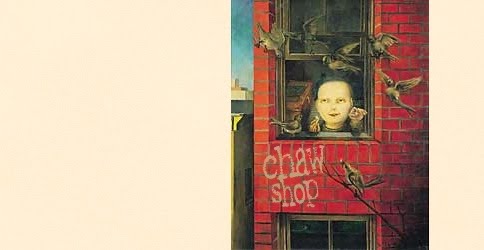
Thursday, April 22, 2010

For Kids of All Ages, pt. 1: Why A?

I recently read an article in the LA Times online about a phenomenon I posted on back in November: the fact that more now than ever, adults are reading novels and fiction series intended for young adults. Spurred on, I guess, by the worldwide success of titles like Harry Potter and Twilight, readers (and thus publishers) increasingly regard these books as intended for an audience far beyond the too-old-to-nap, too-young-to-drive. My initial response to this, as chronicled in my earlier post, was reflexive snark: adults were trying to escape, rather than encounter a genuinely challenging aesthetic experience, and for that reason the whole scene was a damn shame and I was going to have another beer before going to bed. I see now, though, that this attitude is as vague as it is dismissive. The question I failed to ask then, but that I'm asking now, is, "What is it that makes something a young adult novel, rather than simply a novel about young adults?"

It's probably obvious by looking at my earlier posts that I don't believe that a literary work's success hinges on its subject matter. In my life, I have loved books about everything from unicorns to the apocalypse, and found fault with ones whose heroes run the gamut from magicians to hermaphrodites. I also have loved a lot of books with child or teenage narrators. For several years, my favorite novel of all time was Steven Millhauser's masterful Edwin Mullhouse: The Life and Death of an American Writer 1943-1954 by Jeffrey Cartwright, a vision of childhood hallucinatory in its accuracy, purportedly penned by a pre-teen with a Nabokovian vocabulary and a covetous, lonely soul. I already told you how I feel about The Catcher in the Rye, a book all-too-often undervalued by adults precisely because of its appeal to the young. And Huckleberry Finn needs no endorsement from me to demonstrate its self-evident weight and significance (the ending is lousy, though).

These books -- and there are others in their company -- could easily be classified as YA because of their characters and subject matter; the edgy parts of any of the three have nothing on today's reads, where rape, violence, murder, S&M, substance abuse, promiscuous werewolves, pregnancy, and relentless texting are giving parents panic attacks, or driving them to Borders to buy copies of their own. Yet I would argue that, despite the subject matter they chose, Millhauser, Salinger, and Twain's novels are in fact not members of the genre they resemble.  Here's why.

Let me offer, for your consideration, the following theory. The young adult novel is about a flirtation with independence -- a journey that has its roots in the tradition of children's books, akin to the voyages of Max in Where the Wild Things Are or the title character in The Runaway Bunny. In the young adult novel, the protagonist visits the grown-ups' world, but he does not stay: sometimes chastened, sometimes changed, he returns at the end to his childhood for a little longer, usually with a greater appreciation for it now that he knows what's in store. In the young adult novel, there is, beneath all the chaos, a profound faith in order and authority.  Though the protagonist may feel at sea, there is in the end someone -- or Someone -- to take charge, if only he'll let them.

Big Bunny is watching you.

Young adult novels can do beautiful, brilliant things: Coraline by Neil Gaiman is a delight, for example. But there are two things they cannot do (and this goes for young adult movies too). First, they can't intelligently and honestly investigate the inner lives of their older characters; this would make these folks incarnate, fallible, and as such would undercut the whole enterprise, like seeing Jesus on the toilet (eww). Second, as much as they may imbue their teen or child characters with precocious wisdom, this wisdom must always have clear limits, beyond which adult authority endlessly stretches. The child narrator, regardless of his worries or his crimes, must always lack some essential perspective that, when finally grasped at the end, returns him to his rightful place in kid-dom.

The thing that makes a book about a young person part of adult literature, in my opinion, is that the protagonist in question knows just as much, if not more, about what is going on than the adults surrounding him do; that he, in fact, is pointing out truths about grown-up culture that grown-ups can't or won't face. When, given a choice between submitting to what he believes is divine law and following his own judgment, Huck Finn actually rejects God ("All right, then, I'll go to Hell"), he also marks the novel that contains him as a whole different kind of journey than the roundtrip represented by the children's stories noted above. In adult books about children, the child-characters ultimately face the potentially terrifying reality that no one knows what the hell they're doing, that the world is unjust, that some mistakes cannot be undone, and that nobody but Nobody is in charge. They may wish they could relinquish their independence in the end, but there's no going back. They can't rewind the tape.

This is all a long way of leading into what I'm going to talk about in my next post, the novel Extremely Loud and Incredibly Close, a highly original, tenderly poignant, inventively constructed book that I would nevertheless place squarely in the genre of the Young Adult Novel. The book fascinated me for a number of reasons, but perhaps most of all because of what I saw as the schism between the reach of its formal ambition and the thematically inhibited, even precious way it approached certain questions of character, death, and survival. I have many more thoughts on it, but for the time being just let me say it's well worth a read, even if it has some growing up to do. Now if you'll excuse me, I'll be watching the Muppet Show.

Monday, April 12, 2010

The Future of Criticism: or, A. O. Scott, Time to Get in the Fridge

About a week and a half ago, I read a misguided and admittedly self-serving piece on the future of film criticism by the New York Times critic A. O. Scott.  Until recently, Scott – whose reviewing style will one day be remembered as a pioneering influence on the the "Vague-Plot-Summary-Followed-By-Dismissive-One-Liners" school – has continued to believe, despite, as he puts it, "all appearances to the contrary," that the future of criticism is bright.  But this was until what he calls his "own brush with the grim reaper" of contemporary cultural malaise: his syndicated TV show "At the Movies," which back in the day used to star Siskel and Ebert, has finally been canceled. 

Please don't cry.  Here's a little something to help you take the news:

Who needs therapy when you have this picture, seriously?

Anyway.  Scott's article addresses how "At the Movies," which "in its twilight, looks exalted and heroic" (to him), was once regarded as an enterprise that would dumb down the level of the cultural discourse about films into a simplistic see it/don't see it product evaluation.  Ya think?  Citing an older article called "All Thumbs, or Is There a Future for Film Criticism?" by Richard Corliss, Scott writes, "The threat Mr. Corliss identified has migrated to the Internet, where self-credentialed commenters snark and snipe and where the simple binary code of the thumbs-up or thumbs-down voting that Mr. Siskel and Mr. Ebert trademarked has been supplanted by the crunched numbers of the Metacritic score."  Where once we had "James Agee, now there is Rotten Tomatoes."  (Apparently Scott is unaware that if James Agee were writing now, there would be links to his articles on Rotten Tomatoes; there are unfortunately links there to A. O. Scott's.)  But all is not lost.  Scott indicates – and I believe he thinks he's being generous – that the future of criticism is "the same as it ever was," that the detractors of today's internet criticism are no more right or wrong than the generation that took Siskel and Ebert to task for their moronic reductionism.  "How can you do a movie justice in 60 seconds?" he asks, referring to the time allotted for discussion on his now-defunct show.  "You can’t, of course – or in 800 words of print or in a blog post – but you can start a conversation, advance or rebut an argument, and give people who share your interest something to talk about.  And that kind of provocation, that spur to further discourse, is all criticism has ever been."

A. O. Scott is not always wrong, but he is always shortsighted.  And in this case, he's absolutely both.  Criticism has not always been about "starting a conversation," the intellectual equivalent of chatting up a hottie in a dark bar, and criticism at its best is not about that now.  Criticism is fundamentally, ideally, about having something to say.  Now, there are times when that can be said in 800 words, or a blog post, or in sixty seconds of dialogue.  But the idea that extremely limited space or time constraints are an inherent part of the critical enterprise is something A. O. Scott has brainwashed himself into believing, probably because he wants to think the snarky blurb fodder he shells out for the New York Times is the apogee of commentary on film. 

Great criticism, like great art, finds its own shape.  Sometimes it sprawls and meanders; sometimes it explodes.  I think of David Foster Wallace's masterful essay on the films of David Lynch, or Mark Twain's truly wondrous "Fenimore Cooper's Literary Offenses."  But, since A. O. Scott brought up online criticism, I think first and foremost of the best movie reviewer I may have ever encountered.  You might've met him already.  His name is Mr. Plinkett, and he's got just one question for all the pretentious assholes out there:
 What's wrong with your FAAAACE?

Mr. Plinkett isn't a real person.  He's a pizza roll-devouring serial killer, the brainchild of one Mike Stoklasa, a writer/director/Star Wars fanatic, and his bite-your-tongue brilliant, coughing-fit hilarious reviews of sci-fi films have held YouTube viewers as captive as prostitutes shackled to a basement wall.  The same week that trees died for A. O. Scott's misinformed "At the Movies" elegy, Plinkett's epic ninety-minute long review of Star Wars Episode Two: Attack of the Clones was garnering views on hundreds of thousands of screens around the country; Red Letter Media production company, who put this masterpiece online, announced their channel was the most viewed on all of YouTube.

The phenomena of Mr. Plinkett gives me hope, and not just because he's able to attract an audience without the grandfathered-in prestige of a dinosaur print publication or high-overhead cable station.  Rather, I'm blown away by how thorough, and smart, and dead-on-target his critical assessments are -- and by the fact that viewers seem to notice that. 

Here's the thing: in a world where what Scott calls the "democratic forces of the Internet" have supposedly made everyone a potential critic, people can still tell the difference between lame generalizations and incisive, witty critique.  If anything, they're more discerning than anyone could have possibly expected.  To watch a review the length of an entire movie represents a wealth of patience, intellectual engagement, and deep curiosity about the mechanics of narrative that a lot of so-called intellectuals would have us believe flew out the window sometime before The Elements of Style was published.  "But maybe people just find these videos entertaining," a naysayer might argue.  To that, I'd say the fact that Plinkett's reviews are well-written, carefully edited, with masterful comic timing and even fragments of story only serves to further prove that, when given the option, viewers, at least these ones, prefer criticism that aspires to the condition of art.

Only time will tell what the Internet holds for American intellectual culture in general, and for film reviewing in particular.  But I'm hoping that the world of pat, cramped mini-essays and 60-second discussions die with the media outlets that contain them, and that something more idiosyncratic, more expansive, more deeply thoughtful will take their place.  To me, the future looks like a much better time for what Scott calls "a commitment to the independent, open-ended exploration of works of art in relation to one another and the world around them" than the recent past ever did.  Then again, maybe someone's just fucking with my medicine.

Wednesday, March 31, 2010

The Clerk's Tale

When I was a little kid, I idolized the guys who worked at Blockbuster.  In their blue collared shirts, bad haircuts, and cargo pants, they stocked VHS tapes, shuffling dutifully between the shelves as TVs in the corners of the store flashed action scenes with fireball explosions.  The video store guys (and they were all guys) seemed to have sacrificed something important to these glowing boxes, something other people prized: adulthood, maybe?  Happiness?  They joked with each other in movie quotes, drank Jolt, and never seemed to age, caught for all time in a kind of patchy adolescence.  The pictures they preferred were not so much good or bad, but implacably cool, almost sociopathically unsentimental, with unhappy endings and unrated trailers.  They drove to work in dented cars and left with new releases.

These were their patron saints.

The first thing I remember learning about Quentin Tarantino was that he worked in a video store, and this knowledge has informed the way I view his films, especially since Tarantino's aesthetic seems so in line with the aesthetic of the movie guys I grew up admiring.  Tarantino's movies are compulsively meta-cinematic, laden with a dizzying array references to everything from blaxploitation to anime, but first and foremost they're cool: suspenseful and nasty and sarcastic and violent and above all, entertaining.  Emotionally, they're cool to the point of being chilly, and at their worst (like in parts of the second Kill Bill movie), they can come off as empty stylistic exercises, lovingly designed worlds inhabited only by cardboard cut-outs, like the 2D Darth Vader propped up next to the shelves in the sci-fi section.

Inglourious Basterds, Tarantino's latest, is possibly his most interesting film yet, at least for me, simply because rather than fighting this tendency in his work, he embraces and even explores it.  Inglourious Basterds tells the story of a daring military coup: mid-WWII, the head honcho Nazis, including Der Fuhrer himself, pile into a French theater for a screening of Goebbels's latest propaganda effort, a film called "Nation's Pride" about a Nazi sniper who single-handedly killed hundreds of American soldiers in a matter of days.  What the Nazis don't know is that a crack team of American Jews are out to shoot them in the head as many times as possible, and the theater's owner, a disgruntled Jewish Frenchwoman, plans to blow them sky-high by setting her nitrate film reels ablaze.

Here's what I found interesting about Inglourious Basterds.  Like most of Tarantino's films, it takes an older genre as its trope, this time the spaghetti western.  Like Once Upon a Time in the West, this picture starts out with a family killed, heartlessly and unnecessarily, by a straight-up villain, the self-proclaimed "Jew Hunter" Col. Hans Landa.  When we meet Lt. Aldo Raine (with a hick accent from the Smoky Mountains, natch) and his posse, who plan not only to kill but scalp as many Nazis as possible, it seems that Tarantino is laying out a classic story of cowboy justice: good vs. evil, the old American way.  "Nazis ain't got no humanity," Raine declares, and we're inclined to agree. 

But as the movie progresses, Tarantino keeps allowing hints of doubt to creep in.  The Nazis here are not inhuman, at least not all of them.  In one scene, we meet a Nazi soldier whose son Max has just been born; he's beaming with joy over the future of his child, and harmlessly playing bar games with his friends.  In another scene, Shoshanna, the revenge-seeking theater owner, grudgingly admits that her cinema is named for a talented German filmmaker -- an artist is an artist, regardless of nationality.  And even Private Frederick Zoller, the war hero and star of Nation's Pride, is more vulnerable and endearing than is convenient for us to believe: Goebbels calls him a "strangely persuasive monster," and it's true.

At the end of the film, when the Nazis are watching their propaganda movie, crying out with laughter and spontaneous applause as Zoller's character on screen pops American after American with his seemingly unlimited supply of ammunition, Tarantino is certainly poking fun at them.  But he's pointing a finger at us too.  After all, if we're Americans, we've come to the theater for essentially the same reason as these doomed Germans: to watch a triumphant picture in which our enemies are slaughtered en masse, in the most graphic way contemporary filmmaking techniques allow.  Isn't Nation's Pride basically just Inglourious Basterds in fascist drag?  And if so, aren't we a little like Hitler, slapping his thigh and telling Goebbels this is "the best one yet"?  It's an uncomfortable moment of recognition, one that tinges our self-congratulation, our patriotism, with doubt.

In the end, of course, Tarantino lays these doubts to rest.  One of the most memorable motifs in Inglourious Basterds is Lt. Aldo Raine's habit of asking any Nazi in his charge what he plans to do with his uniform after the war.  When the captive Nazi replies he will burn the uniform, or never wear it again, Raine replaces it with something he won't be able to take off: a swastika, inscribed in the Nazi's forehead with the point of a hunting knife.  To Raine, the uniform is not just a costume, the black hat or white hat of a face-off in the wild west.  By donning it in the first place, the Nazi has permanently mortgaged his individual personhood; regardless of who he might be "inside," he no longer deserves to be seen as a three-dimensional character.  Now he's a target.  Raine's just adding the bull's eye. 

Raine's absolutism is appealing in its simplicity, perhaps necessary in a time of war, and the film ultimately endorses it -- but not unquestioningly.  And it's that questioning that makes Inglourious Basterds more than cool for me; it makes it smart.  The guys at Blockbuster would approve, and this time, they'd be right.

Friday, March 26, 2010

Magic for Intermediates

I read The Magicians by Lev Grossman in less than two days. I could not put it down. I read it on the subway, on the bus, on my lunch break, and until the small hours of the morning; I read it in the line at the DMV and on the elevator. I read it in the obsessive, giddy way I read about Narnia and Middle Earth and Wonderland and William Sleator's multiverses as a child, which is to say I read it just the way I imagine Grossman wanted.

The Magicians is a fantasy novel that’s about fantasy, and about novels. It follows Quentin Coldwater, Brooklyn native, type-A personality, and loner extraordinaire, from the day he’s first summoned to Brakebills college for magicians for an entrance exam in his late teens, to sometime in his mid-twenties. Quentin, who grew up on the Fillory and Further novels (a fictional series, loosely based on, you guessed it, the Narnia books) has dreamed since he can remember of escaping to a magical realm, and in the book we find out what happens when he gets his heart’s desire.

This is not your kid sister's magic academy.

Grossman’s prose has the kind of conversational effortlessness that makes any one element impossible to single out and question, a transparent lucidity that makes the images feel like they came straight out of a half-forgotten recurring dream. But what got me, what really pulled me in, was the magic, which was unlike the magic of any other book I’ve read. In The Magicians, magic is not a deus ex machina, a blessing, a duty, or a curse. No one knows what it’s “for”; it reveals nothing, or at least nothing conclusive, about good or evil, the nature of the universe or God or man. Magic heightens sensations, intensifies experiences, endows the ordinary with meaning, but in a way it's profoundly useless. Upon graduation, most magicians end up doing academic research, or undertake “massive art projects, manipulating the northern lights and things like that, decades-long enchantments that might only ever have an audience of one.” Some work undercover, for the government or other organizations, but in a world with “too many magicians, not enough monsters,” they’re not really necessary.

For these reasons, magic in The Magicians functions, for me at least, as a kind of book-length extended metaphor for literature, and the role that discipline plays in the lives of its oft-dissatisfied acolytes. This begins almost at the start, when the Fillory novels are introduced for the first time: “It was almost like the Fillory books… were about reading itself. When the oldest Chatwin, melancholy Martin, opens the cabinet of the grandfather clock… and slips through into Fillory… it’s like he’s opening the covers of a book, but a book that did what books always promised to do and never actually did: get you out, really out, of where you were and into somewhere better.” In Fillory, even the vistas look like the inside of a book; Grossman describes it as “a landscape as black and white and stark as a printed page.”

However, when Quentin learns that magic is real, he discovers that, like literature, it does not spring into being fully formed: “The same way a verb has to agree with its subject, it turned out, even the simplest spell had to be modified and tweaked and inflected to agree with the time of day, the phase of the moon, the intention and purpose and precise circumstances of its casting, and a hundred other factors.” Like an MFA student plowing into the revision process for the first time, he finds himself engulfed in minutiae, the stupid repetitive grit of learning. It is not “an orgy of wonderment”; it’s hard and it sucks. But life without it is unendurable. When Quentin arrives in New York City after graduation, he observes, “Nothing was enchanted: everything was what it was and nothing more. Every conceivable surface was plastered with words… but none of it meant anything, not the way a spell did.” Magic, like fiction, like poetry, spans the gap between thought and reality, between subject and object. Once enchanted, a deck of cards or a glass marble become an extension of the magician’s mind, just as a book is the extension of an author’s. As Quentin’s old professor says, “The separation of word and thing is the essential fact on which our adult lives are founded. But somewhere in the heat of magic, that boundary between word and thing ruptures… Language gets tangled up with the world it describes.”

This conceit is heart-poundingly, throat-clenchingly, head-smackingly brilliant (why didn't I think of this shit?), and for a long time, as I ripped through these pages, I thought the novel would turn out to be an utter masterpiece because of it. Yet as I continued reading, I found myself distracted more and more by a nagging concern that quickly developed into a criticism and ultimately, crushingly, into a full-blown disappointment: the character development of Quentin's lover, Alice.

Everywhere in this book, Grossman calls into question our assumptions about the genre, from a scene where a drunk teenager prepares for an intracollegiate game, snarling, “Gotta get my quidditch costume,” to the impotent, helpless ram who is to Fillory what Aslan the lion was to Narnia. Our hero, self-loathing and melancholic, is a tour de force of psychological realism; no one could mistake Quentin for the aspirational champions of the kids’ books this references. But there’s one escapist trope Grossman has forgotten to send up. A girl who's beautiful when she takes off her glasses, plus brilliant and good in bed; a girl who never makes a mistake in the classroom or on the battlefield, but who's so disarmingly shy and self-deprecating you never feel challenged or emasculated.  A girl who waits around patiently for you to make up your mind if you want to date her, and then has no qualms of her own about leaping into the sack and the full-fledged monogamous relationship.  A girl who's never irrationally bitchy, never self-involved, never needy or demanding or shrill or passive-aggressive or petty or arrogant or mean.  A girl who never tries to defend her weirdo parents and shows absolutely no signs of becoming like them.  A girl who has no friends to compete for her time and attention, no bosom buddies whom you suspect might know her even better than you do.  A girl who has no sexual history worth noting, who never flirts, never cheats (unless you cheat first, and even then she doesn't enjoy it); a girl who puts off her own sizable ambitions while you try to find yourself.  A girl who loves you, only you, unconditionally, even to the point of death – and SPOILER ALERT, who in fact dies, tragically young, sacrificing her life to save yours just after you've tenderly reconciled and she's forgiven all your misdeeds... Well, that's a fantasy, too. And it's one this book doesn't question, not even in a metafictional aside, for all of its 400+ pages.

Grossman didn't make this mistake because he's a male writer; to say so would be letting him off the hook way too easy. Male writers have written devastatingly complex and conflicted female characters (think April Wheeler from Yates's Revolutionary Road, or for that matter, Emily Grimes from his Easter Parade: dude writes like a lady), and female writers have dropped the ball with their fictional counterparts big time (see my post on another magician novel, Susanna Clarke's otherwise masterful Jonathan Strange). No, what Grossman's done here is both simpler and less forgivable: he's allowed his imagination to fail. In a novel where he turns college students into geese, opens a portal in a Brooklyn vacant lot, fabricates a whole fictional world's mythology, and reveals a gorgeous parallel between the magic in books and the books that contain it, he fails to do the first, most obvious thing: turn one of his main characters into flesh and blood.

I still urge you to buy The Magicians, and to read it in the binging, breakneck, flashlight-under-the-blankets way it requires, and to allow it to gobsmack you with the resplendent unfurling of its many mysteries. Most books have flaws, and this one's strengths are as dazzling as a pyrotechnic display made by Illusionist magicians. But if the book's ultimate lesson is that magic is wherever you look hard enough, I wish Grossman had taken more than a passing glance at Alice. Right now, we only see her as Quentin does when they're on their separate treks in the Antarctic: at a great distance, and in a rosy light.

Monday, March 22, 2010

Burn Baby Burn

In the 2002 film Decasia, director Bill Morrison assembles a vast collage of decaying film stock and, with nothing more than a soundtrack, pieces it together into a film-length visual poem.  Vortices of blackness sweep through sunlit scenes. Poxes of dots and splotches swarm over happy dancers; bodies appear lit from within, aura-like outlines of white tracing their bodies, or darkness masks faces unnaturally, as in a photo negative.  Inky waves lap the screen.  The film is a testament both to film's artificiality, its impermanence, its gaps and stutters and lacks, and a celebration of the way those lacks can reveal something – sometimes nightmarish, sometimes beautiful – about the human condition.


Like Decasia, Blake Butler's Scorch Atlas presents itself as damaged goods.  The book, published by Featherproof in 2009, is designed to look like a moldering library volume; on the jacket and on the pages within, we find stains and wrinkles, amorphous dapplings of water and fungus.  The edges of the pages are darkened to look singed.  And the text inside is also splintered: first into 13 sections (stories? prose poems? chapters?) that don't quite hang together as a cohesive narrative, and then at the level of the sentence.  Characters speak in "rhyme and benediction"; the prose cracks into lists, line breaks, call and response. Things "smear," "squirt," "ooze," "froth"; they're "runny," "endless," and everything is damp.

Ostensibly, the book is about a world going through an onslaught of Biblical plagues, or perhaps an apocalypse in stages.  But Butler's not much interested in the breakdown of society; what fascinates him are the imploding families, crushed under disaster's weight.  Rowdy children tie their mother down to suck her breasts, their necks "fat with mold"; a nameless dead baby swells to fill an attic; a mother dies birthing a strange gown for her daughter to wear. 

I'm not going to lie: Butler's language is oppressive.  His sentences are forever turning in on themselves, hiding otherwise straightforward images in twisted syntax ("In the light slurring behind him he watched the streets eject a thing that moved").  This linguistic static muffles even the characters' innermost thoughts ("My brain wormed in want of recognition, turned over and over in cold sputter") or dresses them up in preciously unusual language even when the meaning's clear ("Here's a picture of my first girlfriend, whom I never got a chance to nuzzle").  This is a book where words like "shriek" or "murmuration" can slip by without making a ripple.  It's obvious Butler's not trying to create differentiated narrators, or even characters.  These folks all talk the same, and they're mostly passive victims of the same bizarre calamities.  The main distinction is the extent to which they're bloated with pus and spores. 

Yet, while I usually consider such verbal overkill annoyingly sloppy, in this novel even the messiness contributes to the overall effect.  It's as if the language itself has decomposed, and, like the figures in Decasia, the folks of Scorch Atlas have melded together unnaturally in the resulting corrosion.  I'll be interested to see what this writer does in the future... that is, if there is one.  After reading his book, I'm not so sure.

Thursday, March 18, 2010

Find the Fish

I first saw Monty Python's The Meaning of Life when I was a freshman in college.  At that point of my life, I saw profundities everywhere: in pretentious conversations over late-night nachos, in the garish merchandise of the local Wal-Mart, in endless, debauched theme parties, in the Saturday morning cartoons of my childhood, viewed through the nostalgic haze of grainy VHS.  I roamed the campus in a bowling shirt with the word "COCKTAILS" emblazoned on the back in neon letters, waving one finger in the air, spouting revelations.  I wore sunglasses always, even at night, as though the brilliance of the world was too much for me.  I was insufferable.  I was studying philosophy for the first time, and its lunatic sheen was all over everything; the big questions were not only apparent but urgent, and I looked for answers wherever I could.  It comes as no surprise, then, that I found some of them in a musical sketch comedy from the 1980's featuring, among other things, a singing man in a pink tuxedo who lives in a refrigerator.

What did come as a surprise was that, when I watched this movie the other night for the first time in several years, it still resonated.  The Meaning of Life may be a comedy, but its title is no lie.  It really is about the meaning of life.

In his 1983 New York Times review of the film, Vincent Canby writes, "The Meaning of Life is a monumental revue, the 'Ben Hur' of sketch films, which is to say that it's a tiny bit out of proportion, something like a Brooklyn Bridge constructed to span a bathtub."  The New York Times is usually wrong, but this is worse than usual, and I don't care if I am a lifetime too late in saying so.  The Meaning of Life is a comedy, true, but its scope is exactly equal to its ambition, which is as vast and monumental as the stone tablet upon which its title initially appears.  The silliness of The Meaning of Life does not undercut the points it makes; the silliness is the point.  The film's view of human existence is that it is inherently, unrelentingly absurd.  The only meaning to be found is subjective, and pitiably small when seen in any larger context.

The film centers on one of life's central contradictions: the schism between our desire for abstract, timeless wisdom and truth, and the nasty reality of our physical bodies – the things that are, after all, actually alive.  The film is a virtual catalogue of bodily absurdity: messy afterbirth, sperm, vaginal fluids, dismemberment, slippery organs, menses, and vomit, lots and lots of vomit.  Fortunately for us in the audience, the scatological is only hinted at (by a phalanx of men in lavatories during the musical number "Every Sperm is Sacred"), but the point is clear: the meaning of life is inseparable from the stuff of it, the embarrassing "lowbrow" details that are, in fact, the essential facts of every living thing.  When Eric Idle sings, "Isn't It Awfully Nice to Have a Penis?" or a horde of topless women chase Graham Chapman off a cliff, their breasts swinging in slo-mo, it seems incongruous with the film's ostensible subject, but it isn't at all.  Sex, actual, sleazy, real sex, with all its awkward physicality, neurosis, and fantasy, is the source of everything here; during the galaxy song, even the universe forms the shape of a naked pregnant woman and spreads her legs.  Much more incongruous with the "meaning of life" in the film is in fact religion, whose empty platitudes at their best bear not at all on reality ("Oh Lord, you are so big, so absolutely huge...") and at their worst deny it (as with the Roman Catholics' teachings on contraception).  Patriotism and the military don't fare much better here – everyone has something better to do than "marching up and down the square" – nor do any dogmas that allow us to avert our gaze from life in the flesh, and all its grotesque complications.

I also take exception to Canby's claim that this is a "loose collection of sketches."  Although this certainly isn't a narrative in any traditional sense, it's connected by much more than a "theme of sorts."  Images recur, develop, and, at times, take on an almost nightmarish significance, as in the films of auteurs like Bunuel and David Lynch.  On this viewing, I was struck in particular by the fish and the way their story is woven throughout.  In the beginning, we witness the death of one fish (who's served up for dinner in a restaurant), and the philosophical musing that this incites in his mourning companions.  In the end, we meet Mr. Death himself when a dinner party is poisoned by salmon mousse.  The connection isn't linear, but it's also not accidental.  And perhaps the weirdest moment in this movie – the "Middle of the Film," when a man with Dr. Seuss arms and his tranvestite companion taunt us with riddles – seems to be understood by these fish viewers, though certainly not by us.

If one's ideas are funny, are they somehow less true or important?  I don't think so.  Serious thought and humor are far from opposites; in fact, sometimes the latter is the only way to express the former in a work of art.  It's too bad that laughs are so often an excuse for not paying attention to what's really happening onscreen.  At this rate, we'll never find the fish.

Friday, March 12, 2010

Blunderland

Since the moment I left the theater on Saturday afternoon, dazed and blinking and sugar-shaky from the Mountain Dew I'd just consumed, I have dreaded writing this post.  Of all the writers, filmmakers, and graphic artists I adored in childhood – Jim Henson, William Sleator, Gary Larson – Tim Burton is the one I still love the most, the one whose work has continued to reward repeat viewings and surprise me even long after the initial whizz-bang factor has worn off.  Movies like Beetlejuice, Edward Scissorhands, and Pee-wee's Big Adventure have grown up along with me, revealing themselves to be darker, funnier, and more grown-up than their man-child heroes and toylike props would suggest.  Even while reveling in the gorgeous impossibilities of the imagination (silver screen monsters, tall-tale Americana), Ed Wood and Big Fish, Burton's two true masterpieces, present complicated, emotionally ambivalent views of what it means to be – or to love – an artist.  And recent films like Sweeney Todd and the underrated Charlie and the Chocolate Factory have constructed entire landscapes governed by obsession.  Like Steven Millhauser's hotels or Poe's "Haunted Palace," the settings of these pictures form large-scale models of a disordered human mind.  Tim Burton constantly employs references to film history, folk and fairy tales, television, and pop culture, but the meaning of these references is intensely personal and sincere (a perfect example of what I described in the last post).

Not so with his latest.  If Alice in Wonderland had been made by a lesser filmmaker (and it easily could have been), I no doubt would have succumbed more willingly to its charms.  The computer-animated creatures are, refreshingly, more hallucinatory than adorable, incarnate scratches of a lunatic pen, and the costumes, particularly an array of hats made by a rapidly unravelling Johnny Depp (who lists their names – "porkpie... fez... bowler..." – in a disconcerting whisper) would alone be reason enough to rent this on BluRay.  Some shots, particularly when Alice first arrives in the garden, could be cribbed from a Mark Ryden painting.  But, as one reviewer snarkily put it, this film seemed more like a Burton imitation than the real deal: it lacked the identification, the investment, in its material that characterizes his best work.

I certainly admit that the costumes could have been worse.

Most of the problems came from the screenplay.  I admired their choice to write this as a kind of sequel to the familiar Alice story.  Making her a young adult, rather than a child, could potentially shape her into a far stranger character.  In the first few scenes, I thought she would be.  Alice doesn't wear a corset to a formal soirée – the Victorian-era equivalent of showing up to a catered dinner bra-less in a wifebeater – and she hallucinates during a heart-to-heart with her potential mother-in-law.  The movie seemed to be setting her up as an 1860's hysteric, a stone's throw from batshit Freud patients, Mary Todd Lincoln, and that chick from "The Yellow Wallpaper."  There's even a delusional spinster aunt who seems to represent one of her two possible futures in this world; the alternative, of course, is marriage to an unbearable prig.  I'd go crazy too.

For all intents and purposes, Alice is trapped, and though her situation in this film is new, the nightmarish frustration she feels is familar.  After all, the original Alice books commented on a deeply illogical society that hid itself – just barely – behind a highly structured class system and the rote proprieties immortalized in children's etiquette texts.  In the books, when Alice succeeds, it's not because she's changed the system; she's simply learned to manuver within it, flattering the powerful, playing croquet by the rules, and munching on the large and small mushrooms at just the right time.  The only real escape from the madness is to wake up.  Showing Alice as a powerless grown woman, though, raises the stakes by suggesting a new question: What if the reality outside of Wonderland was just as oppressively nuts as the reality within it?

The filmmakers choose to avoid this question by yanking any potentially troubling elements out of the story.  First, they remove the insanity from Wonderland.  It becomes a simplistic video-gamescape where good battles evil and wins.  Then they remove the insanity from the real world frame.  In the Victorian era of this film, all a woman has to do to become an entrepreneur is point at China on a map.  When movie-Alice returns from her trip down the rabbit hole, looking like a ravished victim of Del Toro's Wolfman, her would-be father-in-law offers her a job and the last we see of her, she's set off on a business venture around the world.  Just in case we didn't catch it, Wonderland's caterpillar (now a butterfly, natch) flutters across the screen to herald her transformation.

This is nonsense, but it's not the interesting kind.  Watching the film, I found myself wondering why they chose to make Alice in Wonderland when the result was something a lot more similar to a half-assed version of the Wizard of Oz.  Like Dorothy, Alice here travels to a magic world where, along with a quickly assembled team of friends, she picks sides in a battle between a good witch and a bad witch; like Dorothy, after kicking ass, she chooses to return home to confront her problems.  There's even a "Scarecrow-I'll-miss-you-most-of-all" moment with the Mad Hatter, of all people.  Yet unlike Dorothy, the Alice of this film doesn't have a clear goal, a clear point of view; there's nothing like Toto she's trying to protect, and her psychology isn't reflected revealingly in the fantasyland her mind creates.  In fact, the Wonderland of this movie isn't a fantasyland at all: it's supposed to be a real place that Alice first visited as a child.  Her subsequent dreams of it are a form of PTSD, I guess, though how and why she went there in the first place is never explained.

Watching Wonderland just seemed to me like touring a theme park of missed opportunities.  As a misunderstood dreamer in a world of Victorian summer whites, Alice could have been a tragic Burtonian figure – à la Edward Scissorhands – whose happiness is not quite possible in the world she inhabits, but whose imagination is hauntingly beautiful just the same.  Instead, she's become a pawn, both in the hands of the White Queen and in the hands of the filmmakers.  Her actions are meaningless, hollow gestures, motivated by nothing internal.  I never mind it when a Burton character is dead, like Beetlejuice or Large Marge; I only hate it when they're dead inside.

Monday, March 8, 2010

We Don't Need No Education


I first fell in love with Henry Darger when I saw the 2004 documentary about his life, In the Realms of the Unreal.  A janitor by trade, he gained fame posthumously for his writings and especially paintings, which depict the epic struggle of the innocent, pint-sized Vivian sisters against the forces of evil, represented by the Glandelinians, an army of rifle-bearing men wearing "college professor hats" (mortarboards).  I've since seen his work at MoMA and the American Folk Art Museum on several occasions, and each time I love it more and more.  The other night, flipping through a catalogue of his prints, I was thinking about why.

As readers of this blog have no doubt gathered, I am a sucker for many things, but my first love is probably postmodernism.  By that, I'm referring especially to artists and writers who appropriate images from history and pop culture, transforming them into raw material for something new.  Whether it's a Patton Oswalt stand-up routine (wherein he declares that during the apocalypse, Avril Lavigne will appear in the sky to recite the Good Will Hunting screenplay while sentient razors slice at our flesh) or a Thomas Pynchon novel (where Malcolm X and Mickey Rooney make cameo appearances), there's something about this technique that, in the right hands, works like catnip on me. 

And yet, paradoxically enough, a lot of art I've hated employs these same techniques.  Watching the second Shrek movie was akin to having a strand of piano wire threaded in one of my ears and out the other, and Moulin Rouge gave me the queasy feeling associated with eating a meal entirely made from refined sugar.  Cultural icons -- Porky Pig, Elvis, the Disney castle -- can come trailing associations and emotions: nostalgia, comfort, desire.  But they can also carry with them an aura of corporate impersonality and cynicism, functioning as placeholders for content the work's creator was too lazy or unimaginative to provide.  Characters are not beautiful, but "beautiful," not evil, but "evil," and we know at once what response they're meant to elicit, despite the fact we feel little to nothing at all.  Far from sending up consumer culture, postmodern works of this kind can seem like just another product of it, manufactured on a storyteller's assembly line, where interchangable parts are twisted together efficently, each functioning the same way in a different machine. 

Here's where Henry Darger comes back in.  Entirely on his own, with no formal artistic training or in fact, much education of any kind, Henry Darger invented postmodern techniques.  He traced, copied, and photographically enlarged images from magazines and coloring books; he pasted in images snipped from illustrations.  Yet, unlike the makers of, say, The Family Guy, he did this entirely without irony; his paintings neither wink nor nudge.  His desire was completely sincere: to create in reality the world in his head.  His postmodernism, like a modern cave painting, employs any and every available tool, without disdain for any of them, and without a concern for genre or "school."

In fact, I think it's fair to say he didn't like school.  (See college professor hat, bottom left.)

In a way, Darger's naivete legitimizes postmodernism for me, because it reveals that the logic of appropriation isn't merely something learned -- an artistic shorthand, a trick.  Rather, in the context of our modern society, it's something primal, even primitive: a dialect we grow up speaking, almost despite ourselves.

Sunday, February 28, 2010

Do You Believe in Magic?

Believe it or not, working at a low-level position in the publishing industry does not have many perks.  I do not spend my days clad in a bikini of diamonds body-surfing through a Scrooge McDuck swimming pool of coin, nor do I speed a company Mercedes convertible down the West Side Highway as part of my morning commute.  However, when I get lucky, I do get to see an occasional Advanced Reading Copy of a book before it's published, and this time, though I am not affiliated with Random House or any of its imprints, I was fortunate enough to get my greedy paws on Aimee Bender's new novel The Particular Sadness of Lemon Cake, which doesn't come out till June.  I'm not going to write a full review here, because, as the back matter sternly indicates, the galley takes its text from uncorrected proofs and is not to be confused with the finished product.  I also feel like I need to give the book another chance, since I was suffering a lingering hangover from my latest Pynchon binge when I cracked its spine.  But it did get me thinking a bit about magical realism, so I thought I'd jot down some thoughts on that subject while they were still fresh in my mind.

In a recent interview, the New Statesman asked Jonathan Lethem if he considers himself a "magical realist."  Lethem's response was both pithy and hilarious: "I've always resisted the phrase, finding both terms - 'magic' and 'realist' - shaky at best, with unwelcome or unexamined assumptions camped out all around them. Some of this reaction is deeply rooted: as a child I hated the whole disingenuous kabuki of stage magicians. I identified with 'Hot Town, Summer in the City' but not 'Do You Believe In Magic?'"  Although I disagree with what he goes on to say about Marquez, something about this statement resonates with me (and it's not just the image of a pint-size Lethem critically assessing birthday party entertainers and the oeuvre of the Lovin' Spoonful).  "Magic" or "magical" are words that, when applied to fiction, do indeed summon up "unwelcome" associations: of pure escapism, of children's books, of deus ex machina, of "fate" or "destiny" subbing in for legitimate character motivations.  The same slipshod approach to storytelling that scared me off of superhero films as a genre until recently has many intellectuals rejecting "fantastic fiction" sight unseen.  A friend of mine recently mentioned a former professor who refused to rent the Lord of the Rings films because he wouldn't watch anything "that has unicorns in it."  Though his students explained that unicorns were in fact not in evidence in any of the three films, he would not be dissuaded.

The Fellowship of the OMG PONIES!!!!1

Yet magic is a primordial force in storytelling, one that predates anything resembling "realism" in the collective imagination of mankind.  Tales of God or gods, of talking animals, of heroes on unlikely quests, form the foundation on which our current literature rests.  A few weeks ago, I was lucky enough to see a magic show at Proteus Gowanus art space in Brooklyn, where Acep Hale, street performer extraordinaire, integrated his flawless execution of classic tricks (no "disingenuous kabuki" here) with a lecture about the role of the shaman in historical narratives from ancient times to the present.  The shaman's arc -- a descent into an underworld of some kind, a reforming of the person, and a re-emergence changed -- is one of the most basic stories we as humans tell ourselves, and it accounts at least in part for our fascination with figures from Harry Houdini to Jesus Christ.  But a story doesn't need a shamanic character to take its cues from the magical.  Even superficially plausible modern fiction (like the later epiphany stories of Ray Carver, the family epics of Faulkner, the degradations of Mary Gaitskill, etc.) is often structured in ways that intentionally evoke myths, religious parables, and even fairy tales.

So why is it that when magic is literalized in a story, it often gives the reader pause?  The Particular Sadness of Lemon Cake offered me some clues.

Sadness centers on an ordinary young girl, Rose, who at age nine, discovers she has a magical power: the ability to taste the emotions of the chef in whatever food she consumes.  I haven't read Bender's last novel, but her short fiction often centers around characters whose emotional states are similarly made manifest.  (For example, in her story "Marzipan," a man who loses his father wakes up with a hole in his stomach the "size of a soccer ball"; his wife gives birth to an old lady who looks and acts just like her departed mom.)  These stories read as metaphors, smart and small.  Yet in Sadness, Bender extends her conceit for nearly 300 pages.  As the story progresses, Rose comes to prefer pre-packaged food, created in factories, which, oddly enough, she distinguishes first and foremost by their geographic locations: Louisiana, New Jersey, Kentucky.  She discovers her mother's infidelity from a platter of roast beef, and ultimately finds work in a French restaurant where the food is "beautiful."  But unlike, say, Dickens, Bender isn't obsessed with the sensuality of food: for a book with "cake" in the title, her descriptions of flavors, aromas, textures are cursory at best.  When Rose embarks on a tour of LA area restaurants (seeking that elusive thing, a truly happy meal), what we get mostly amounts to a list.  And Bender's not obsessed with cooking either, its rituals and necessities and jargon, the way it carves up time: in fact, except for the initial cake-baking scene, the most memorable evocation of food preparation is in a short description of a factory with a "no touch" system where enchiladas slide off a conveyor belt without ever encountering a human hand. 

I think what interests Bender most is the psychology of the characters.  But that psychology is glossed over, too.  The problem here, as I see it, isn't the magic but the realism.  It's clear from the way she writes Rose that Bender wants her to be a relatable character -- ordinary, likable, familiar -- living in a world very like our own.  Rose loves a handsome older boy, a friend of her brother's; she worries about popularity and her parents; she learns to drive.  Bender makes a point of telling us that Rose has no particular interests, nothing to set her apart; the great tragedy of her young life, along with her parents' troubled marriage, is that her brother is the family genius, tormented and beloved, while she's only average.  Bender also endows her with a magical power, one that would, realistically, make anyone she described it to think she was crazy, or lying, or both.  It's a power that disorders her relationship with food, that allows her to read minds, a power that was granted by an unknown force or that results from a profound, unheard-of mutation in her genes.  Yet somehow, Rose does not fear she's going insane; she doesn't use her ability to manipulate those around her; she doesn't research the phenomena and find others of her kind; she does not become convinced that her superpower makes her superior to her peers, called for some peculiar mission, or inferior, cursed by an unseen Creator.  She doesn't go to great lengths to keep it secret, but, until the final pages, she also doesn't press the issue with anyone who would feel compelled to react: her parents, a teacher, a psychiatrist.  (At one point she mentions it to a distracted school nurse, but they speak at comical cross-purposes; her one childhood freak-out is easily resolved when she eats a bowl of chicken soup.)  She does not even become anorexic or obese.  Bender does not allow the magic to bear meaningfully on the realism, and so the magic stays removed from it -- abstract, fanciful, and therefore tough to swallow, if you'll pardon the pun.

Because, as I said, I'm not reviewing this book here, I won't delve into the subplots about Rose's brother's disappearances, her grandma's care packages, or her father's fear of hospitals, and I won't try to address the overall structure or prose.  I'd also like to add that Bender is a highly original writer, and I'm not coming to any final conclusions about the novel just yet.  But I will say that it's this kind of magic that gives me pause as a reader.  I will accept anything in the world of the story: an apocalypse, dream logic, clones, time travel, a tiger loose in Manhattan, a boy who can fly, yes, even unicorns.  (Thank you, Haruki Murakami.)  All that I ask is that the author stay as fascinated with her own magic for long enough to explore its natural conclusions.

Tuesday, February 23, 2010

The Mid-Day Report

If a short story is shorter than a novella, and a novella is the kid sister of the novel, then it stands to reason that there should be something that dwarfs all of these: a novellum?  A novelot?  Though we may not have a name for the form, that doesn't stop Pynchon from writing them.  It's not just the length I'm referring to here: Jonathan Strange and Mr. Norrell, for example, is hardly shorter than one of Pynchon's tomes, and the Harry Potter series, viewed as a single work, is double the length, if not triple, of any one of Mr. P's masterpieces.  But I'd hardly claim Clarke or Rowling's books exist outside the category of Mansfield Park and A Tale of Two Cities.  Their plots obey familiar rules; their structures fall into patterns the average novel-reader can easily predict.  The fact that they can be serialized easily, as multiple volumes or as a series of films or miniseries, reveal them to be nothing more than a series of friendly, approachable fictive units, sitting atop one another's shoulders, clad in a stiltwalker's clothes.

Pynchon, though, is different.  Just as a giant is distinguished not only by his height, but by his curious phrenology, the otherworldly proportions he displays in his limbs and hands and feet, so too are Pynchon's novels marked even at the level of the chapter, the paragraph, the sentence, as the mutants that they are.

An artist's rendering of AGAINST THE DAY alongside two other novels

As readers may remember, I embarked on my ill-advised journey into the giant's mountain cave back in December, when I began reading AGAINST THE DAY.  I am sad to report that after two full months, I am only halfway through the novel(lum), and no closer to unlocking many of its mysteries. 

AGAINST THE DAY is not just a historical novel, but a novel about the past: about innocence, about boys' adventure novels, about the legacy of parents on their children.  And about time travel, let's not forget that.  We move through its pages like these ghostly visitors from a tainted, darker future, unable to quite touch the characters who -- with their blazing red hair or their uncorrupted sensual passions or their inescapable missions or their half-mystical scientific theories -- seem to fly through the world fueled only by air and wonder.

What is this book about?  Icelandic spar.  Revenge.  Two women named Estrella.  Anarchy, dynamite.  A family of magicians.  A dog who reads.  The World's Fair.  A zeppelin.  A harmonica academy.  Venice.  A vehicle that explores under sand.  Eternal youth.  Photography.  An avalanche.  A weapon based on time.

I am not going to lie to you: it is very difficult to follow the "story" of AGAINST THE DAY.  There are several threads I can think of off the top of my head: the story of the Traverse family, headed by patriarch Webb, an anarchist bomber, whose children Reef, Kit, Frank, and Lake scatter in all directions after his untimely passing; Dally Rideout, whose father Merle raises her when her mother runs off to form a new family with impresario Zombini the Mysterious; the Fraternity of the Venturesome Chums of Chance, a crack team of do-gooders who, it's strongly implied, are at least in part fictional; Lew Basnight, an amnesiac detective who uses explosives as a recreational drug and pals around with Englishmen Neville and Nigel; Yashmeen Halfcourt, a beautiful mathematician -- and on and on.  And, as I suggested before, these stories hardly break down into managable fictive units.  Characters appear in passing, then return to dominate a section or chapter; Pynchon lavishes detail on settings that, like the World's Fair, are rapidly dismantled before they can ever be fully explored.  Reading this book is an exhausting experience.

And yet.  I went away over the weekend, and on the train struggled through some fifty or so pages of this novel, only to set it aside.  I felt frustrated that I had not finished the book yet, that I wasn't even close, and that it seemed like I would need to start from the beginning as soon as I finished, if I wanted to be able to comment meaningfully on it.  I planned this blog post to be a tombstone to the reading project, an admission of defeat, a white flag raised to the forces of the forty-hour work week and the Playstation 3.  And yet.  On the train ride back, I read another novel, one I'll talk about in the next post, perhaps, a light, approachable novel about cakes and high school, and it happened to me again.  That old feeling, the same one I had after finishing GRAVITY'S RAINBOW: the feeling that next to Pynchon, nothing has substance, nothing has depth.  And it drove me back to AGAINST THE DAY. 

Because next to Pynchon, everyone looks like a midget.

Tuesday, February 16, 2010

I Mean It's Like I Don't Know What

Over the weekend, I saw my first Mumblecore movie: Funny Ha-Ha.  I've seen films by Jean-Luc Godard, John Cassavetes, Francois Truffaut, and other New Wave/cinema verite auteurs, but nothing I've come across in the past quite prepared me for this.  In description, the film sounds simple enough: it tells the story of a young woman named Marnie, who works as a temp (later she becomes a professor's assistant); she's attracted to one guy, makes out with another who's attached to her friend, and goes on a few dates with a third.  In the beginning, she drinks too much -- then she stops.  We learn that she wants to play chess and spend more time outside, because she makes a to-do list. 

But Funny Ha-Ha is a bizarre cinematic experience, for one primary reason: not only is this movie nearly devoid of meaningful action, it's also nearly devoid of meaningful information.  There are no telling details here.  While a film like Clockwatchers (for example) also tells the story of a lonely temp to whom nothing much happens, that picture fetishizes certain images, endowing them with power and meaning: a green plastic monkey, the clock of the title.  The office setting there, though drab and depressing, is depicted memorably, almost as a character in the film: rearranging the temps' desks becomes an act of betrayal.  With the exception of one scene where Marnie finds a packet of birth control pills in a potential boyfriend's desk, though, the characters in Funny Ha-Ha hardly interact with their settings or the objects within them.  Scenes are vaguely grounded in apartments or on the street or in other interchangable locales; the camera rarely, if ever, hones in on anything besides a person's face.  We never get a sense of the relationships between the characters, their shared history, or their individual backgrounds.  Even the actors' physicality is nonspecific, fidgety, and vague.

All of this probably sounds like criticism.  But in fact I thought Funny Ha-Ha was beautiful and fascinating and deeply, compellingly strange, and for me it raises an interesting question about storytelling.  The popular wisdom seems to be that, if the viewer/reader is confused, he will get bored and abandon whatever story he's watching or reading.  But often, when a film or book refuses to directly offer the elements of conventional narrative – character motivation, for example, or exposition – I find myself seeking those out, almost desperately, from whatever material is available.  When one character in Funny Ha-Ha suddenly and inexplicably gets married (off-screen, of course), I project onto his situation all kinds of possible explanations: maybe his new wife guilted him into it?  Maybe there was some practical reason – health insurance, a green card?  Or maybe his attraction to Marnie has frightened him?  Far from boring me, puzzling over this question draws me deeper into the film than many plausible explanations could.

Though the characters in Funny Ha-Ha are unguarded, awkward, and vulnerable, the experience of watching the film is far from intimate.  On the contrary, the viewer becomes a voyeur.  We don't know these people.  These scenes have not been prepared for us.  We rifle through them, as Marnie rifles through the materials on her would-be lover's desk, piecing together a story from whatever clues we can find.

Tuesday, February 9, 2010

Thought Experiment: Ghostbusters

Imagine, if you will, a world where poorly executed fake Picassos go for more money than work by the best contemporary artists, even though it's tacitly understood that they're made by unemployed grad-student painters. Imagine a world where random character actors grace the Broadway stage, but are credited in the program with names like "Scarlett Johansson" and "Claire Danes." Imagine that the lip-synching acts, a la Milli Vanilli, dominate the music scene. Imagine that all of this is an open secret, and nobody says anything, because nobody cares. If that sounds outlandish to you, then take a good look at the New York Times bestseller list any week of the year. I'm willing to bet that half the titles you find there are ghostwritten.

Ghostwriting is a parasite eating the face of American literary culture. And I'm not going to lie: I've tasted that face myself. I doubt there are too many writers in the NYC area who haven't at least contemplated the possibility on occasion. Ghostwriting is a decent way to make a few thousand dollars as a struggling novelist, and for those who excel at it (like Chronic City's Oona Laszlo), it's not a bad way to make a living. Although it's nigh well impossible to survive financially as a literary writer, I know of at least a few people who are able to keep out of poverty ghosting full-time, and I don't fault them in the slightest. Nor do I really take issue with the "Authors," the folks whose names go on the spine. Often celebrities, politicians, or major successes in other fields, they've paid their dues, and who can blame them for wanting to share their knowledge, their stories with the world? Wanting to see yourself on a library shelf isn't the worst form of hubris I can imagine.

Yet therein lies the problem. The whole point of a ghostwritten book is its physical presence: there is the "author's" name on the cover, his photograph on the back. Though the words inside are not the author's per se, the book is his, and thus an object worth desiring. As we move into an era where the book qua physical object is increasingly separated from the content within its pages, though, I wonder what the consequences of this paradigm will be. Through ghostwritten titles, publishers have trained readers to devalue the actual formation of language into narrative, meaning, idea. The content, i.e. the writing itself, is treated as a commodity, easily farmed out to the lowest bidder; the "author" (and his "platform") is the product. But as we gain ever-greater access to these "authors" through streaming video, Twitter feeds, podcasts, and the like, what does a ghostwritten book offer that sets it apart?  Immediacy?  Even when a book is "crashed," or published in the minimum amount of time possible, it can't compete.  Greater accuracy?  Book publishers aren't exactly known for their fact-checking.  A handsome binding?  Forget it, says the Kindle. So, without the jacket design, the creamy heavyweight pages, the glossy photo inserts, what will be left of the author for publishers to sell?

This is why I consider ghostwriting a face-eater. The only way to make books relevant in an increasingly digitized world is by valuing writers not for their ability to promote and publicize their work, but for their ability to, well, write it: beautifully, intelligently, distinctively. Because books aren't made of paper and ink anymore, if they ever were -- they're made of words. Funny how easy that can be to forget.

Monday, February 8, 2010

Chronic City, pt. 3: Why So Serious?

"When we speak of 'seriousness' in fiction ultimately we are talking about an attitude toward death -- how characters act in its presence, for example, or how they handle it when it isn't so immediate... (I suspect one of the reasons that fantasy and science fiction appeal so much to younger readers is that, when the space and time have been altered to allow characters to travel easily anywhere throughout the continuum and thus escape physical dangers and timepiece inevitabilities, mortality is so seldom an issue.)"  -- Thomas Pynchon, Slow Learner (Introduction)

Over the weekend, I was thinking a good bit about this statement, and how sneakily true I've found it to be over the last few years.  In my post on violent movies, I talked a little about what I saw as violence's power to make characters real, or more precisely, corporeal, to place the viewer in their living bodies -- to shift the focus from what happened (good or evil, right or wrong) to the necessarily more complex realm of how it happened.  But, more even than violence, I think that the role of death in a work of fiction can lend characters this reality, or conversely, rob them of it.

After I read Chronic City, I struggled to articulate what made Perkus Tooth so real to me as a character.  A larger and perhaps more interesting question, though, is why anything in the world of that novel felt as significant to me as it did.  Chronic City presents a landscape burgeoning with pop culture references, and satire, and stoner humor, and sex.  Eagles and tigers render characters homeless; an installation artist digs big holes in the ground.  And Lethem is well aware of the hilarity of all this, playing even poignant moments for laughs: for example, when Perkus's heart is breaking, he "blame[s] the nearest cultural reference he [can] find"; when he and Chase are fighting over a burger waitress, he refuses to celebrate Thanksgiving, ostensibly "out of respect to Sacheen Littlefeather."   The epic quest for the grail-like chaldron takes them to -- where else? -- ebay.  In a certain way, the book sets itself up to be dismissed (a "baked Seinfeld," as one reviewer put it). 

And yet, from the beginning, death circles this novel, just as the birds circle Insteadman's church spire, just as Janice Trumball's doomed space station orbits the earth.  When Chase first meets Perkus, he observes, "With Tooth's turtle's posture and the utter slackness of his being... I could have taken him for elderly... [but] he was in his early forties, barely older than me.  I'd mistaken him for old because I'd taken him for important."  Perkus's fragility, and his failure, are the open secret of this novel, the first and truest fact of him.  And though his quests and his brilliance and the bizarre accumulated complexity of his life and relationships for a time overshadow this in the reader's mind, it's his vulnerability that subconsciously sticks.

The same is true for the other characters.  At the funeral where Oona and Chase initially pursue their love affair, Chase describes "the shameful survivor's lust I've known to sometimes wash over me at funerals, the giddy, guilty apprehension of one's own continuing lucky freedom to feast and fuck and defecate, to waste hours flipping cable channels watching fragments of movies or half solving crossword puzzles then tossing them aside, to do pretty well anything but sit and honor the memory of another whose lucky freedom had run out."  When he and Oona flee the funeral together, they are fleeing death.  Yet the two of them are no less mortal than Perkus or, for that matter, the now-deceased Junrow.  When they visit the Urban Fjord, a child asks Chase if he's the same boy from the sitcom reruns; "You look old," he says, to which Chase replies, "I am old."  And Oona?  "Her frame wasn't strong enough to carry around a coat heavy enough to warm her."  Neither of them are indestructible.

Throughout the novel, the characters seek to halt the inexorable forward motion of time through language, argument, art.  Oona keeps Janice Trumball alive through the letters she ghostwrites; Biller removes the fact of Brando's death from the star's Wikipedia page; Insteadman's younger, immortal self is preserved on VHS as if under glass.  And marijuana, their substance of choice, is known for its strangely slowing effect on one's perception of time.  This is not your teenage brother's stoner novel.  Only in forgetting the past, however temporarily, can these characters ignore the looming fact of a future where they'll have vanished into complete insignificance.

As Heidegger says, death is the essential fact of one's existence; though someone might sacrifice himself for my survival, no one can die my death for me.  That death is my own.  On further reflection, I think it is Perkus's death, more than anything else, that provides the center, the grounding, to his vast and complicated character, just as the presence of death does the same for the larger world of this novel.  In his descriptions of Perkus, narrator Insteadman creates, at moments, an illusion of the infinite: "[Perkus's] mind's landscape was epic, dotted with towering figures like Easter Island heads," he notes upon their first meeting.  Yet what ultimately defines Perkus, renders him tragic, is his finitude.  Perkus never knows romantic love; he is a pawn in the conspiracies of others; his body is falling apart; and even his verbosity, his intelligence, once met its limit: "It's like when I tried to write a book, Chase.  Practically every day I had to remind myself what it was even about, why I'd even started it!" he confesses in their final conversation.  Insteadman wants us to mistake Perkus for important, for larger than life, just as he did; he wants to immortalize Perkus.  But it's Perkus's unimportance that brings him to life -- and makes his death heartbreaking.

I'm not interested in quibbling over genre terms.  Some people have described Chronic City as science-fiction.  It's also fucking hilarious.  But, when I return to the Pynchon quote, I can't help but think of it first and foremost as "serious fiction."