Showing posts with label movie. Show all posts

Thursday, April 7, 2011

In the Realms of the Unreal

Before I went to see Zack Snyder’s new film Suckerpunch last weekend, I watched the trailer – for the fourth or fifth time and in my usual state of fist-pumping enthusiasm – ostensibly for the purpose of showing a friend who’d agreed to come along what we were in for at the local Imax. Amid my exclaimed profanities and endorsing narration (“Look at the composition of that shot! And that one! Also: zeppelins?!”), he managed to get the gist of the preview, and said, once it was over and he could get a word in edgewise, “It’s a little like Henry Darger, don’t you think?” To which I squealed, “Oh my god, you are so right!” and nearly keeled over from the sudden rush of ticket-buying endorphins flooding my bloodstream.

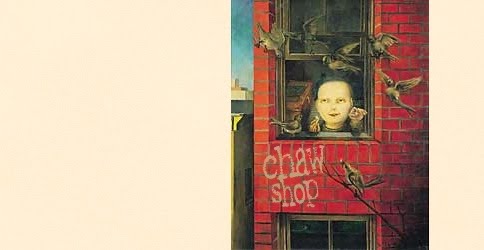
Frequent readers of this blog will know that my affection for Zack Snyder is matched by few things, and one of those things is my passion for Henry Darger, the Chicago janitor who, working in total solitude, spent decades of his life creating a mammoth illustrated novel entitled In the Realms of the Unreal. This volume tells the story of the Vivian sisters, blameless children fighting a battle in a magical, Narnia-like realm against a confederacy of male evildoers wearing what Darger described as “college-professor hats” (mortarboards). My buddy was right on in seeing the parallel between this vision and Snyder’s admittedly juiced-up fantasy of Lolitas in peril. Darger’s postmodern visual technique involved pulling images from everywhere in commercial low culture – advertisements, coloring books, magazine illustrations, tabloid photos – via tracing, collage, and later, photo enlargements for inclusion in what was a bizarre, obsessively personal world. The sisters in particular were cribbed from clichéd paradigms of girlhood innocence, cloying figures wielding beach buckets or cowgirl hats while all around them, apocalypse unfolded. Replace Darger’s newspaper comics and Coppertone girls with anime, graphics-heavy videogames, classic sexploitation, and some back issues of Heavy Metal, I figured, and you’d be looking at something like Suckerpunch. In both cases, the characters the story follows are paper dolls, flat and familiar to the point of near invisibility. The mind we’re actually exploring is the creator’s – Darger’s and Snyder’s, respectively.


In some respects, Suckerpunch did not disappoint this expectation. The movie is fucking gorgeous, for starters. In four of the movie’s set pieces, we watch Baby Doll (Emily Browning, looking like the platonic ideal to which so much plastic surgery aspires) duking it out with clockwork samurai, steampowered doughboys, dragons, and a monorail full of robots. With enough money, anyone can film gadgets and explosions (and anyone has), but Snyder has a deep understanding of the choreography of fight sequences, and a painter’s eye for the panoramic landscapes in which they play out. As four music videos – or more accurately, silent films, since they each outlast the duration of a single song – these would be rococo, ridiculous delights.

The trouble, for me, comes from Snyder’s attempts to cram the dodecahedron of his imagination into the square hole left by recent Hollywood successes. I’m speaking here of that inconvenient thing: the movie’s screenplay.

If, unlike me, you weren’t too distracted by the trailer’s pulsating soundtrack or its images of badass dragons to see the warning signs, you’ll have gathered that the story’s frame concerns a mental institution from which our heroine wishes to escape. Her attempts are psychotically reconfigured in her ailing brain, first into a strip club/whorehouse and then into the action numbers described above.

This frame is a regrettable choice for a couple of reasons. First, it necessitates a series of scenes in which Baby Doll and several other characters talk. Let me be perfectly clear on this point: none of these characters should speak. Ever. It is totally unnecessary and invariably embarrassing when they do. I’m not maligning the actresses, who do the best they can with dialogue that sounds like it came from a cut scene in Panzer Dragoon Orta. But, if their sexy goth Halloween costumes discouraged us from imagining these women’s inner lives, their conversations confirm they have no inner lives at all. In Snyder’s masterpiece Watchmen, I considered the over-the-top obvious exchanges (“What happened to the American dream?” “It came true! You’re looking at it!”) to serve the same purpose that the superhero stances on window ledges or in fiery hallways did: the characters were striking poses, iconic ones, that served to define something significant about themselves. But in Suckerpunch, to put it bluntly, the dialogue is boring and meaningless. While writing this post, I referred to IMDB in hopes of finding some “memorable quotes” from the film to cite, but except for the fake-mysticism twaddle from the movie’s inexplicable voiceovers, even that resource seems to consider most of what these ladies say eminently forgettable.

Because Baby Doll is not believable as a character with an inner life, period, Snyder exacerbates the second and larger problem with the story's frame. It’s effectively impossible for the movie’s stunning dreamscapes to have originated in her mind. According to the production materials, the mental institution is supposed to be set in rural Vermont in the early 1960’s; because of the sepia tone, Edward Gorey-esque set design, and our heroine’s vintage sailor dress, I pegged it for even earlier. Regardless, though, the story comes from an era prior to the vast majority of the film’s many allusions and centers on a character who, as far as we can tell, is ignorant of all of them. Let’s be real: why would an orphaned cutie in New England during the Eisenhower administration fantasize about destroying androids with a samurai sword? Why would she imagine racy dominatrix outfits for all of her friends? Why, in fact, does the story that she tells herself have the structure of a videogame?

And most importantly, what does it add to any of this imagery to claim she’s the one behind it? Ultimately, this is where I got stuck. The visual world of this movie is interesting precisely because of what it suggests about the imagination behind it, an imagination saturated in the popular culture of the last 50 years. Suckerpunch has been polarizing for a reason: just as Darger’s obsession with the Vivian girls’ courage and virtue led him to create exceptionally disturbing images of violence against children, so does Snyder’s apparent girl-power message contain an immutable gender binary and a prominent rape fixation. Where is that voice coming from? Claiming it’s all in Baby Doll’s head feels like a cop-out, one that insults the intelligence of the viewer – or, alternately, suggests that Snyder has no idea what his picture is really about.

I’m not saying that’s the worst thing. Artists don’t always know what they’re up to, or where the dark heart of their material lies. I claim to love Darger, but I’ve never read the thousands of pages of fiction that accompany his dazzling paintings, and I probably never will. It’s certainly possible to enjoy the action sequences in Suckerpunch as the stunted masterpieces that they are and ignore the rest. But if Snyder wanted to make a full-length film with this material, and supply it with an accessible emotional and psychological arc, I would have suggested he take a page out of Charlie Kaufman’s book and insert himself – or a character like himself – into the picture. By doing that, he would have foregrounded what’s unsettling and original about the movie by making us complicit: sympathetic with the type of male gaze that condemns lechery and sexual aggression while only calling women by their stripper names, with the form of escapism that celebrates bloodless violence without consequences. And even more than an icepick, that’s the kind of thing that sticks in a viewer’s mind.

Friday, October 22, 2010

Child Neglect: Some Thoughts on Emma Donoghue's Room

Kids say the darndest things -- especially in contemporary literary fiction, where they have a tendency to shoot their mouths off on every subject from 9/11 to their own rapes and murders.  As a device, child-narration can be tough to pull off, but when it works, it's equally tough to resist.  In his introduction to the Vintage Book of Amnesia, Jonathan Lethem cites amnesiacs as a natural subject for fiction, since invented characters, by their very nature, come to us without pasts, assembling themselves before our very eyes: "Conjured out of the void by a thin thread of sentences, every fictional assertion exists as a speck on a background of consummate blankness."  Child characters are the same way, newly arrived and bewildered in a realm of unexplored possibility -- with an added bonus, too: as young creatures with still-developing minds, they are by nature curious, full of wonder and energy and the potential for intense joy or sadness over the most seemingly insignificant things.

Yet, when child-narration succeeds, it succeeds not because the child in question stays a blank, an innocent, but because she rapidly acquires her own specificity: because we see the adult person within her forming and transforming, struggling to get out.  In his 2005 masterpiece Tideland, filmmaker Terry Gilliam tells the story of a lost child, Jeliza-Rose, who finds herself orphaned in a run-down farmhouse on a featureless plain when both of her parents die from drug addiction.  Despite these dire circumstances, she subsists on her imaginings, and her beautiful visions of sentient Barbie doll heads, talking squirrels, floods, and rabbit holes share equal time with the setting's increasingly grisly realities (her neighbors include an overzealous taxidermist, and the subject of a botched lobotomy with a stash of dynamite under his bed).  In a wonderfully weird introduction to the picture, Gilliam explains, that he's finally found his inner child, "and she's a little girl."  It's clear from watching the movie that this is true.  Even amid disaster and horror, Jeliza-Rose quickly reveals she is no tabula rasa for viewers to project their own child-selves onto.  Like Gilliam himself, she has a distinct, idiosyncratic sensibility that would be recognizable no matter what world we saw refracted through her eyes.

It isn't just what she sees, but the way she sees it.

Emma Donoghue's novel Room starts with a similar premise.  The novel's narrator is Jack, a five year old boy, who is growing up in a grotesquely disturbing home environment: an eleven-by-eleven shed in a maniac's backyard.  His mother, we learn, was kidnapped and imprisoned there at age nineteen, and since then, she's been raped almost daily by the psychopath (referred to only as "Old Nick," not his real name), who keeps her alive on a meager diet of frozen foods, canned goods, and pain pills.  But, like Jeliza-Rose, he's never known a normal life, so to him, "Room" is the world: magical at some moments, frightening at others, but never monolithically vile.

In my opinion, the best moments of this novel unfold in this setting, a place at once otherworldly and plainly, grittily observed.  It's clear that the story is set in the contemporary era -- Jack watches Dora the Explorer on TV -- yet the touches of pop culture, rather than grounding us, make the situation seem even more surreal and impossibly removed.  Room is a realm where the traditional categories of realism versus fantasy no longer clearly apply.  Divorced from the context of larger civilization, Jack and his mother are forced to construct their own society, their own rituals and meaning, and although these behaviors often seem escapist and deluded, confronting their daily deprivations would not just be unlivable for the mother, but incomprehensible for Jack.  Instead, she teaches him to live in life as they know it, without an inkling of anything beyond the contents of their cork-lined cell.

A person's world is defined, we begin to see in Room, not by objective "truth" or even the sum total of knowledge available to humans somewhere, but by the knowledge passed down by authority figures within his particular community.  The whole of North America was once unknown to Europeans; the whole of Europe was once unknown to North Americans.  And Jack's mother doesn't speak Spanish, so to Jack, Spanish is not a "real language."  For him, food or books or toys don't exist until they get inside Room; the idea of their manufacture or purchase is just as mind-boggling as a time before the universe's creation.  He has no idea that Old Nick's nightly visits to his mom's mattress had anything to do with his own conception.  And fairy tales are just as real as anything on the evening news.  This is not magical realism, but reality as the speaker knows it.  And, if Donoghue lingered for longer in Room, allowing Jack to engage with this reality as he grows up (or even just grows a little older), we would come to learn just as much about the particularities of his character as we would about a kid, say, in the Middle Ages, who treats bloodletting as a hated inevitability in service of a greater good (like modern orthodontics), but who still has other qualities, other traits and interests, that make him distinct.

Unfortunately, just as Jack is beginning to come into focus, rebelling against certain of his mom's restrictions (tellingly, his first disobedient act is to come out of the wardrobe where he sleeps at night to take a good look at his father/captor) while continuing to accord with others, Donoghue suddenly moves the plot in a whole new direction.  Jack's mom begins to dismantle the ideas she's imparted to him since birth, fessing up that other boys and girls, sky and trees, are not "just TV," but real things, just past the door.  And SPOILER ALERT, she's planning an escape.

It's at this point that, for me, Jack as a character begins to recede.  His first experiences with the outside world, including a chase sequence where he leaps out of a moving truck, are page-turning stuff, and Donoghue makes a good point by showing him as more terrified and homesick than anything else as he encounters people and situations that just weeks earlier would have seemed as strange to him as taking a trip to Mars.  But after a few pages of listening to him wax nostalgic about Rug and Sundaytreat (the one special item they got to ask Old Nick for each week), I realized, with a sinking feeling, that Donoghue really had no idea who this kid was.  Jack's actions and interactions, his desires and fears, are profoundly predictable, scars left by his confinement.  But there's nothing more personal under them, no sensibility at work that we could recognize even if his experiences had been different.

And so Donoghue switches gears.  Jack becomes a passive observer of his mother's struggle to re-acclimate herself, and the story suddenly becomes something I'd flip past on Lifetime.  In what's easily the worst scene I've read in awhile, Jack throws a temper tantrum just before his mother is supposed to be interviewed for TV -- so she brings him with her (to which I must say: WTFFF?), and he sits, silently listening and hardly commenting even in his narration, as she delivers seven and a half pages of exposition and directly stated thematic material.  This is a disaster for the novel, not just because of the laziness of the fictive technique, but because it betrays the novel's central conceit: that Donoghue is at least attempting to relate this from the perspective of a plausible five-year-old.

OK, I get that Jack is smart, and that he's been trained to parrot back what people say on talk shows (it was part of how his mother taught him vocabulary back in Room).  But being able to parrot back what a person said is a far cry from understanding it, or even finding it interesting.  And, with the swirling newness of everything that would go into this event -- the lights, the cameras, the wires, the boom mike, the tech guys, the clipboards, the makeup -- I find it completely absurd to suggest that Jack would sit there, attentively listening to every word spoken, without ever becoming distracted or having a strong reaction of any kind.  Donoghue has completely lost interest in him as a character, and it really fucking shows.  If he were a real child, the treatment the author gives him in this scene would be akin to forgetting to pick him up at day care and leaving him there for four days.

The book never recovers from this huge misstep, in my opinion, not even with its lyrical tearjerker ending (though I'll admit that passage, a callback to Jack's mother's favorite storybook Goodnight Moon, is crudely effective even in its obviousness).  And once I shut the cover, I found myself wondering why it all had to go so awry.  Donoghue created a wonderful kid in the early chapters.  It's just criminal that she let him die of total neglect.

Monday, October 11, 2010

It's a Zoo in Here: Animals in Fiction

When I was a child, one of my earliest lessons about fiction was on the component parts of a story: the primary ones hit upon were conflict, setting, theme, and characters.  Our teacher explained that "characters" were the "people" in a story, the actors who either caused the action or suffered the consequences of it.  I immediately raised my hand to ask if stories that featured only animals were then in fact stories at all.

Obviously, as my second grade teacher explained to me then and as I am well aware now, personified animals or even inanimate objects (from Toy Story's Woody to Asimov's robots to Pynchon's Byron the Bulb) can just as easily function as the protagonists and antagonists in fiction as actual living humans can, and many great stories, especially for kids, feature relationships between humans and non-humans front and center.  In stories of this kind, the enchanted creatures become the child's imagination externalized, made flesh, and tend to either mirror the child's thoughts about the adult world (Alice in Wonderland, The Phantom Tollbooth), provide fantastical tests for real-life moral quandaries (The Chronicles of Narnia, the film The Labyrinth), give the child the opportunity to reverse roles and take on the duties of protector or parent (The Indian in the Cupboard, the films The Iron Giant or ET), or supply reliable friendship and comfort while allowing the child to explore his identity outside of the confines of family (Winnie the Pooh, the comic strip Calvin and Hobbes).  In all of these cases, though the creatures themselves certainly have independent goals and motivations, we see them through the child's eyes, and ultimately, we judge them in terms of the effect they have on the child in question.  As much as a reader may like a talking faun or a lovable robot, it's clear she's not meant to locate herself in those characters.  By definition, they are the Other.

We're aware that we see this character through the child-character's eyes.

For that reason, something odd tends to happen in stories where people and their civilization are conspicuously absent: we are forced to identify with someone inherently dissimilar to ourselves.  As a kid, my first exposure to stories of this kind was in Aesop's fables.  Interactions between a fox and a raven or a cat and the mice it pursues were unsettling, not just because of the unmitigated cruelty and violence (no second chances here), but because these animals, unmoored from the context of my world, were deeply unpredictable to me.  One story in particular, the fable of the scorpion and the frog, was especially creepy: a scorpion hitches a ride on a frog's back to cross a fast-flowing river.  The frog is uncertain if it should trust the scorpion not to sting it, but as the scorpion points out, if it stings the frog mid-journey, they will both sink and drown.  Still, in the middle of the river, the scorpion stings his companion anyway.  Why?  "It's in my nature."

What does this mean, "It's in my nature"?  Is the scorpion good or bad, active or passive?  Does a scorpion have free will?  Even as a young child, I knew that humans are sometimes slaves to their own biological imperatives: the need for a bathroom on a road trip, the need for a puke bucket during flu season.  Was the scorpion's need to sting akin to these exigencies?  Or was its need to sting more like the other, less uncontrollable urges I experienced: the temptation to palm a roll of Lifesavers from a convenience store or to break my toys in the midst of a tantrum?  If the scorpion had been placed in a story with a little girl, it would have been clear where my sympathies should fall -- the scorpion would be a villain, or, simpler than that, a mere danger, like a lit stove.  But in Aesop (whatever he may have intended), this clarity was lost to me; try as I might, I couldn't locate myself in either character.  Although the altruistic frog was certainly more lovable within the context of the story, the scorpion's needless cruelty raised questions about him too.  If a scorpion's nature was to sting, then what was a frog's nature?  And if that nature was just a matter of instinct, genetics, not something chosen, then wouldn't his potential for goodness or badness entirely depend on whose perspective the reader chose to adopt?  After all, if a story were told about the frog from the point of view of a fly, the frog would seem inherently evil too.

One of the big complicatons in stories entirely about animals comes with personifying more than one species of animal at a time.  I call this the Animal Farm effect.  In the novel Animal Farm by George Orwell (which does, in fact, briefly feature humans as well, though not in the same way as the kids' stories I described above), a mass revolt against an unjust farmer leaves the animals in charge.  Yet, over the course of the story, the pigs -- originally placed in a management role because they are the smartest of the animals -- take on more and more of the qualities of humans in their interactions with the other barnyard creatures, until finally they are living almost exactly as their human masters once did, inhabiting the farmhouse and walking on two legs while others serve them.  The rules of the farm, which once represented the interests of all, are now reduced to one simple credo: ALL ANIMALS ARE EQUAL, BUT SOME ARE MORE EQUAL THAN OTHERS. 

Orwell, who was using the story to make a statement about Stalinist Russia, clearly meant for us to reject this maxim: the barnyard animals are all sentient, all capable of speech, and thus all equal on the novel's terms.  But I think that "all animals are equal, but some are more equal than others" does reflect something that's frequently true about the use of animals in fiction.  When creating a world dominated by animals, something must still be regarded as the Other in order for the animals' social order to be comprehensible to us -- in order for their life to at all resemble the relationship of human society to the natural world.  Even in Animal Farm, rats, songbirds, and rabbits play this role: the other animals attempt to "tame" them (signalling to the reader that "tameness" is the "humanity" of animals in this scenario) but without success.

The mid-90's Disney film The Lion King, for all its many embarrassing faults (if I never hear the saccharine song "Hakuna Matata" again, it will be too soon), succeeds in this one respect, at least.  With the exception of a meerkat, a wild boar, and a toucan -- all of whom are treated basically as servants and comic relief -- all of the speaking characters are predators, and the prey are basically de-personified.  In one memorable scene, a herd of bison trample a lion to death, not out of anger or a desire for revenge, but because they literally cannot be reasoned with.  They are running out of blind, unarticulated animal fear, seemingly unable to understand or even hear the cries of the main character for help.  For some lions to be "good" and some "evil," for the choices of a lion to have any moral weight, we must first establish that the central nature of a lion qua predator is morally neutral.  And we must do that by making it clear that the story is told from a lion's perspective.

I got to thinking about all these issues over the weekend, after seeing Zack Snyder's fun, gorgeous, and intermittently disappointing kids' feature, Legend of the Guardians: The Owls of Ga'hoole.  After Watchmen (particularly the magnificent, absurdly ambitious, aggressively postmodern ultimate cut version, which I wrote about here, here, and here), I doubted he was going to top himself with a picture about magic talking owls, and unfortunately I was right.  However, moments of this picture are still fucking glorious, beginning with a sequence at the beginning when an owl swoops down to snatch a mouse off a branch and then continues effortlessly in its flight.  There are a few ornithological non-sequiturs throughout (one plot thread asserts that owlets can be turned to zombies by being forced to stare at the moon as they doze off -- a weird idea, considering that the laws of nature and even the film itself firmly establish that the little dudes are nocturnal), and a feel-good musical montage that made the Lion King soundtrack seem as edgy and smart as Sweeney Todd's in comparison.  But the movie's best moments come when we see owls' own natural behaviors unexpectedly invested with emotional import. 

"Branching," when owlets glide from branch to branch while learning to fly, is a little like athletics, a little like driving lessons, yet not exactly like either: it occupies a space in an owl's life not quite equivalent to anything in ours.  And an even better scene (easily my favorite moment in the film), comes when the little sister of the two main owlets hawks up her first owl pellet, a solidified mass of mouse bones and fur that resembles something fossilized.  Panting and traumatized, spittle dripping from her beak, she stares in horror at the thing her body has just unwittingly ejected, while her nursemaid, a dippy snake, bustles around saying things like, "Oh, it's a beautiful day, the day of your first pellet!"  "You mean," the stunned chick replies, voice quaking with trepidation, "it's going to happen again?"  Vomiting up an owl pellet is a little like menstruation is to humans, yet it also happens to boys; it's a bit like losing a tooth, but it never stops, not even in adulthood.  At heart, it's a thing that happens only to owls, and it isn't transformed to parallel directly with human experiences -- but the way they respond to it, socially and personally, seems more or less the way people would, if people were owls.

Sure, they look real cute... until you see the gunk that comes out of their mouths.

In this sense, stories about animals or other non-human characters can be deeply subversive, and not just because they allow the author to veil controversial opinions under the guise of fantasy.  Rather, these stories are subversive because of the way they allow readers or viewers to set aside their own perspective to emphathize with one that, by its very nature, is profoundly foreign, even disturbing or grotesque.  Especially for kids, but really for all of us, that's a lesson that can't come soon enough.

Thursday, September 23, 2010

Send in the Clones

I am not a proponent of the faithful film adaptation.  Many of my favorites (like Stanley Kubrick's Lolita or Terry Zwigoff's Ghostworld) veer wildly from their equally magnificent source material, and others (like Tim Burton's soul-consuming masterpiece Big Fish) actually improve upon the so-so books they tackle.  To me, the important thing is not that a movie is true to the vision of the book upon which it's based; I only care that the movie is true to its own vision, that it creates, in its characters, settings, and story, something that takes advantage of the visual medium and creates a world unto itself.

However, when a film adaptation systematically skips over all of the incidents that made the novel original, poignant, and tenderly observed, when it drops out emotional complexity and internal conflict from its depictions of the characters, when it strips settings of their power and objects of their meaning, and when it neglects to replace any of these elements with anything, anything at all, besides horrible treacly predictable Hollywood schlock -- well, it's at those times that I wish I'd waited for the DVD.  In his lovely and accomplished novel Never Let Me Go, Kazuo Ishiguro describes a landscape through the eyes of the main characters, who have just, for the first time, left the boarding school where they grew up.  "We could see hills in the distance that reminded us of the ones in the distance at Hailsham, but they seemed to us oddly crooked, like when you draw a picture of a friend and it's almost right but not quite, and the face on the sheet gives you the creeps," he writes.  Mark Romanek's mediocre film adaptation of this very novel gave me a similar feeling, except that instead of "the creeps," one could more accurately say "the intense desire to cram Junior Mints in my ears to muffle the awful score."

 
Inside, I was screaming.

To be fair, the movie isn't all bad.  Romanek used to be a music video director (he also did the spooky Robin Williams vehicle One-Hour Photo), and he's decent at creating the film's visual world, which alternates in mood between a scruffy-preppy teen fall fashions photoshoot and the chilly operating rooms of Cronenberg's Dead Ringers.  And the actors are all right, although in the later parts of the film, the exaggerated naivete and perpetually open mouth of leading man Andrew Garfield made me wonder if maybe his brain was in fact his first organ donation. 

But the real problem here is the screenplay, a despicably shallow and mechanistic interpretation of the irreducibly complex relationships evoked by the book.  After a 10 PM showing last night, I actually went home and reread over a hundred pages of Never Let Me Go, just to make sure I wasn't crazy for having liked it in the first place.  I wasn't.  One of the things the book excels at, above all else, is revealing the thorny and delicate nature of lifelong female friendships.  The main character, Kathy H., and her best friend Ruth are close from the age of six or seven on, but this closeness isn't static: they draw close and pull apart, again and again, in a kind of dance.  Superficially, Ruth is charismatic and social, more "popular" than her quieter friend, and there are moments when she holds this over Kathy.  Yet Ruth is also intensely needy and vulnerable, desperate to be loved.  Kathy understands this about Ruth in a way that no one else seems to; her attunement to Ruth's often minute internal fluctuations of mood make her irreplacable, but also provide her ample opportunities to call Ruth out on minor pretensions and casual half-truths.  Neither girl is perfect, but their friendship with each other is precious, the defining tie of their childhoods and early adult lives.

The famous "Bechdel Test," taken from the comic strip "Dykes to Watch Out For," was derived from a panel where a character states she only will watch a film if it satisfies the following three requirements: it has to have at least two women in it, who talk to each other, about something besides a man.  I think treating these components as prequisites is misguided and limiting -- many terrific movies feature only male characters, or only a man and a woman, or only a single woman navigating a male-dominated environment.   However, I do think that this rule speaks to something that is regrettable about the way that female interaction is often depicted onscreen. 

Case in point: in the stupid, stupid screenplay for Never Let Me Go, Ruth and Kathy's entire relationship is reduced to their mutual attraction to Tommy, a boy from Hailsham.  Kathy loves Tommy.  Ruth steals Tommy.  Ruth gives Tommy back.  The film turns Ruth into an evil man-eater and Kathy into a pathetic, sniveling victim.  In this scenario, there is no reason for the girls to be friends, nothing between them except for barely concealed hostility, resentment, and competition.  Yet the movie, for some reason, expects that viewers will invest in the girls' connection with each other -- that when they reunite, after ten years of separation, we'll care.  Huh?

Moreover, this set-up reduces Tommy to an object, a pawn, entirely and inexplicably under Ruth's control.  It's clear he and Kathy are sweethearts from day one; as small children, they exchange loving glances with such irritating frequency, it's like they're auditioning for an episode of the Wonder Years.  But when Ruth decides she wants him, he takes her hand without hesitation.  If the movie chalked this up to the fact it's Keira freaking Knightley, I'd believe he was just under the spell of an intense sexual attraction.  But instead, it's weirdly apparent that he takes no pleasure from their love affair -- he even covers his eyes while they get it on, I guess to think of Kathy.  So why is he with Ruth at all?  I guess because he's a pathetic, sniveling victim too.  He and Kathy really are soulmates... that is, if they have souls at all.  I have to say that, by the end of the picture, I still wasn't entirely convinced.

Never Let Me Go is a science fiction story in that it has a speculative premise: these characters are being raised to donate their internal organs as adults.  But even in the novel, this premise is the weakest part.  I never really found it believable that the majority of ordinary people would accept the practice of raising clone children just to slaughter them for their livers and kidneys.  I can't imagine what kind of science would necessitate the creation of full-fledged human donors with personalities rather than organs grown independently, or harvested from insentient bodies cultivated in farms.  Even the widespread passivity of the donors is tough to swallow -- although I believe it about the students from Hailsham, whose misplaced loyalty to their alma mater keeps them from entirely turning their backs on the purpose for which they were raised.

Yet though I do think these logistical problems mar the novel, Ishiguro manages to deflect attention from them by keeping the focus on the personal, the everyday: the shades of meaning in an off-handed comment, the inside jokes and odd slang, the awkward hedonism of the characters' one night stands and communal porno collections.  (As a sidenote, I think it's interesting how much sex Hollywood removed from this story.  In the book, donors are unable to conceive children and thus are encouraged to enjoy casual sex for pleasure, even as young teenagers -- Kathy herself sleeps around compulsively. In the film, of course, she's treated as a repressed and saintly virgin, while smokin' hot Ruth stalks around post-coitally in a short robe: yet another way their friendship is dumbed down to fit catfight cliches.)

In other words, Kathy, as the book's narrator, is not concerned with the big picture of the world in which she lives; she's interested in the particularities of the people and places who have meant the most to her in her life, and she evokes these characters and settings so skillfully, so effortlessly, that it's tough not to feel like you've known them yourself.

In the movie, though, there is no such veil of minutia to shield us from the plot's gaping holes and so, at the very moments when we're meant to feel, we find ourselves thinking instead: about how the hell all of this could come to pass, about when it's going to end.  Fortunately for us, if not for the characters, it's all over sooner than you'd expect.

Wednesday, September 22, 2010

Spoiled Rotten

A few weeks ago, I was lucky enough to finagle a free ticket to an advance screening of the hot new documentary film Catfish.  I thought the movie was terrific and unsettling, but this post isn't primarily about that.  This post is about the marketing strategy for that film, especially the tagline on its posters ("Don't Let Anyone Tell You What It Is"), and about the concept of spoilers in general.


As you may have noticed in my reviews of books and movies on here, I don't tend to shy away from talking about the twists or surprises of a story's plot (although I do give last-minute SPOILER ALERTs as a courtesy).  To me, it seems impossible to discuss the work as a whole without making reference to the way it concludes, even/especially if that conclusion demands a reconsideration of the entire story that preceded it.  Yet, as a viewer or reader myself, I do like to approach a narrative with as few preconceptions as possible -- not just about the ending, but in general.  My own tendency to inflate my expectations for works made by my favorite writers or directors often amps up what would be moderate dissatisfaction to all-consuming anguish (Tim Burton, for the love of God, why?), and sometimes the early reviews or buzz surrounding a project will harden my heart against it, either out of writerly jealousy, that bitter green-eyed editorial assistant of the soul, or out of resentment toward what the author/director/story "represents" -- ignoring, of course, what the piece actually is.  To me, the purest experience of new work would probably involve a blindfold, a mallet to the back of the head, and a rude awakening in a world where civilization creeps along atop the smoking ruins of mass media and the blogosphere.  Until the Great Server Apocalypse claims us all, however, I tend to regard book and movie reviews as something best consumed after experiencing the work, when I'm desperate to join some sort of conversation with others who are wrestling with the same questions I am.

Back to Catfish, though.  I don't think it's weird or bad that the filmmakers want to keep the story's conclusion veiled in secrecy: they're trying to draw in viewers through the sheer force of curiosity, one of the oldest tricks in showbiz (PT Barnum would surely approve).  But there is something a little odd about the fact that commentators, whether or not they enjoyed the film, have adhered so closely to the creators' wishes -- especially considering that the meatiest and most reaction-provoking parts are in the last third or so, when the mystery rapidly unravels. 

I'm not going to buck the trend and give away anything about the picture here, but I think it's fair to say that the movie is more of a character study than a horror story, and like any good character study, it thrives on detail and psychology, not on the lynchpin of any single incident or "reveal."  And moreover, I think the makers of Catfish made it that way on purpose.  Their footage (and the way they edited it) shows they weren't just after the one-two punch of their dramatic revelation.  In fact, it's in those later parts that the film becomes the most impressionistic: I'm thinking in particular of a scene at the beach, and of the movie's title, which, far from being a coy hint, actually comes from a weird and poetic anecdote that relates to the story's action only metaphorically.  All of this demands discussion, dissection, argument, yet none of that is happening in the public sphere.  The filmmakers want to "get people talking" -- just not the people who have already seen the film. 

The concept of spoilers comes, I think, from the idea that criticism is like a product review: that the reviewer's role is to tell potential readers or viewers what to buy.  In this model, criticism is not so much a response as it is a preview: an advertisement or a warning label, depending.  It's not a perspective that intrinsically values criticism as an art, one that should be whole and complete in itself.  Instead it says that criticism must be good for something, for someone.  It also puts an expiration date on reviews' cultural import, at least for films and books that become well-known enough to enter the popular consciousness.  Imagine reading an essay about The Crying Game or The Sixth Sense that played coy with those films' third-act disclosures.  Such an essay would seem almost aggressively irrelevant, not only revealing little about the films' own internal structures but also next to nothing about how or why their endings spoke to the public's obsessions -- like an article on the 2008 election that didn't mention who won.

Yet, when filmmakers or reviewers do divulge a story's secrets -- even if they're not so secret -- the public tends to rebel.  I've been fascinated by this second phenomenon occurring with another film that just came out: the movie Never Let Me Go, based on the novel by Kazuo Ishiguro.  I haven't seen the picture yet (I'm planning to go tonight), but I'm puzzled by the fact that so many folks, both online and in print, have flipped out about the alleged spoilers in the film's preview and pre-release coverage.  Metro, the free NYC daily that my dog uses for toilet paper, even titled their review, "Never Watch the Trailer First."  OK, I guess I should throw down a SPOILER ALERT of my own, but: really, guys?  I haven't seen the movie yet, but in the book the supposed "shocker" is strongly implied even on the very first page.  That "shocker" is in fact not a twist, but the premise: that the characters are clones who are going to be used for organ donations.  Their understanding of this fact is riddled with denial and contradiction -- they wish it could be avoided, they sometimes picture other futures -- just as our own understanding that we will all die someday comes accompanied with many hopeful caveats.  But they know, and the story that transpires in the book is in many ways concerned with that knowledge: with what it suggests about timidity, passivity, the desire to please authority, to conform at any cost, versus the forces of self-expression and love.  The fact that people are responding so strongly to perceived spoilers where there are in fact none suggests to me something larger is at work here.

We live in a culture saturated with entertainment options.  It isn't possible to read or watch everything, and it's completely understandable that people (including myself) want guidance on what to consume that does not completely forecast the work in advance.  But I also think that informed, thoughtful, and comprehensive  responses to narrative shouldn't dumb down or silence themselves.  I'm not sure what the answer is.  All I know is that Bruce Willis is a ghost.

Tuesday, July 20, 2010

He's Dreamy

Ever since I can remember, I've been fascinated with the connection between dreams and storytelling. After all, dreams are the first stories we tell ourselves, the first narratives that – like it or not – engulf and overwhelm our senses, that can move us (at least for a moment) with the same power real events do. Dreams raise the fundamental questions of human existence to us in a way that is impossible to ignore. I don't think that children are afraid to go to sleep just because they fear the specific apparitions who haunt their nightmares – Ronald McDonald, a garbage can with teeth, a taxidermied moose head with hard glass eyes. I think they fear it for a deeper, more primal reason: because sleep is the one place they have to go by themselves, without adult protectors, and whatever lurks there is theirs alone to face. If "no one can die my death for me," as Heidegger suggests, the journey into dreamland may be a more temporary death, but it's no less isolating. And it comes as no great comfort that the monsters there come from inside ourselves. Though that might make them less real in one sense, it also makes them far more difficult to permanently escape.

For those reasons, I have never agreed with Henry James's asinine generalization, "Tell a dream, lose a reader," nor with the more commonly held opinion that dreams stall the action of narrative, that they hold characters in artificial stasis. To know a character's dreams is, in my opinion anyway, to know that character's humanity; it provides the same intimacy as witnessing his birth or death or the intricacies of his sexuality. In fiction, details have to be carefully chosen, whether they're the contents of a wallet or the tchotchkes on a shelf, but although those details may work on a metaphorical level toward developing the protagonist or themes, they also have to operate impersonally, causally, in accordance with the laws of the story's world. In depicting a dream, though, that causality itself functions as metaphor. Objects shift, transform, appear, disappear in ways that mirror the character's psychology; there are no accidents, no rote necessities. Everything means something. In this sense, I think that, only in a dreamscape (or a landscape that functions like one, as in Kazuo Ishiguro's masterpiece The Unconsoled or the films of David Lynch) can plot itself aspire to the lyric condition of poetry.

The Christopher Nolan film Inception does not aspire to the lyric condition of poetry. Inception aspires to the condition of the summer blockbuster, specifically of the whiz-bang variety; it aspires to pack in as many twists and turns and explosions and car crashes, gun-toting extras and special effects, as is legally possible to cram into a PG-13 two and a half hour extravaganza. Like Space Mountain, it is a hell of a ride, and if you can get through it once without throwing up, you may find yourself tempted to get back in line and go again, because it leaves you so exhilarated and refreshed.

These are accomplishments, huge ones, and they're even more impressive when you consider all the seemingly obligatory things the picture doesn't do. Inception is a movie where, in the course of the present action, no one dies or gets laid; it's a heist movie where nothing gets stolen. The characters are ciphers, with hardly a defining characteristic among them – there's a single memorable beat of romance/comic relief, when Joseph Gordon-Levitt cons Ellen Page into a kiss, but other than that the characters are little more than attractive mouthpieces for hefty chunks of technical sci-fi exposition. Yet the story moves: there's always a ticking clock or a ticking bomb, a bullet to dodge, or – in the most literal sense of the word "suspense" – a white van hanging off the side of a bridge, falling in slow, slow motion to the chilly waters below.

It feels silly even to bother pointing out that this film is overcomplicated to the point of absurdity: "Whose subconscious are we going into now?" Ellen Page asks at one point, in a line of dialogue that I suspect was taken verbatim from a confused reader's marginalia on the screenplay. It feels silly, too, to point out the overdetermined Freudian arc of the dream narrative. For the five of you in America who still haven't seen this movie, Leo & Co. are tasked with implanting an idea in a young CEO's mind: they need him to dismantle the energy company he recently inherited from his dad. I WILL BREAK UP MY FATHER'S EMPIRE, Leo pens on a whiteboard during a strategy meeting of the mind-invasion team. "The most powerful ideas have emotional meaning," he explains to those assembled. "But how do we turn a business plan into an emotion?" a clueless flunky asks. I guess for this guy, a cigar is just a cigar.


Perhaps the human mind isn't so complicated after all.

But, although I did find moments in the film unintentionally funny, that wasn't why I was so disappointed in Inception. For me, the biggest let-down here was the simple fact that the dreams did not remotely resemble dreams. As I said before, dream worlds in fiction are fascinating to me, not simply because they can be fantastical, imaginative, wondrous, and strange (though those things can come as additional perks). What makes dream worlds fascinating is the fact that everything within them is the construction of a particular idiosyncratic human mind. If I recall correctly, Freud believed that the raw material of dreams came entirely from objects and images the dreamer had encountered in life; dreams were in this sense vast collages filled with items that never entirely relinquished their initial significance, a whole world hued with nostalgia. Inception takes this idea one step further: since the agents access the dream state consciously, they can build within it consciously too, creating impossible architectures and landscapes that defy the laws of physics at the speed of thought. But given this freedom, what do they create? The sets from the Bourne Identity movies, apparently, and, in the case of Leo and his wife Mal, an empty city of repetitive fascist architecture, with one or two replicas of their former homes at the outskirts.

This looks boring, sure, and it tells us zilch about the characters, but the problem is bigger than that. By showing us dreams but refusing to let them convey any information through suggestion or metaphor, Nolan is devaluing the whole visual aspect of his very visual medium. He's saying, "You don't need to watch; you just need to listen, and everything will be completely explained." And by encouraging this kind of passivity, this inattention, in the viewer, he's drawing attention away from the very qualities that could meaningfully distinguish his work from that of his contemporaries. Like the dream-architects here, Nolan could've made this look like anything in his imagination – he could have made this personal, haunting, zany, or gorgeous. But except for one or two amazing moments (as when a vast gray city folds in over itself like a piece of curling linoleum, or a very old Ken Watanabe eats porridge in a room with a thousand hanging lanterns), he chose to make this world look like any random thriller at the multiplex. Perhaps making us believe the third-act twist, about fantasy and reality being indistinguishable, was more important to him than creating a visually arresting film. But even with that twist in mind, I'd encourage Nolan to take a look around the world outside the shooting set sometime. The Earth can be a pretty weird place. That's why it gives us such bad dreams.

Tuesday, July 13, 2010

Will It Bend? (pt. 2)

I saw The Last Airbender movie on Friday, and already I've forgotten most of it. The reviews are right: it is leaden and pretentious, afflicted with some of the worst child acting I've seen in a long time. In fact, Dev Patel, playing moody Prince Zuko, is the only one who even attempts to create a character, rather than squintily reading his lines from some giant cue card with improper punctuation positioned just offscreen. Yet, unfortunately for Patel, the script betrays him at every turn, offering him little more than ponderous exposition and a fight scene against the Avatar that looks more like two kid brothers wrestling in a cluttered garage. The other actors here do not even deserve our pity, although their characters are written just as badly, or worse. In possibly the most amusing moment of the film, Aang sits down to meditate in a holy place in the Northern Water Temple. "Some monks can meditate for four days!" he exclaims. He positions himself and closes his eyes. Four seconds pass. "Aang, can you hear me?" his friend Katara asks.

I could talk about some of the other bizarre decisions Shyamalan made regarding the story -- probably the weirdest was his decision to have benders execute an entire series of complicated dance moves before their various elements respond, which makes the "action" sequences move about as quickly as a poorly prepared middle school pom pom routine. But the greatest disappointment of this film is that it's not even fun to tear apart. Unlike the truly amazing crap films of the 1980's (including the gloriously depraved Howard the Duck, the epic failure Dune, and Trancers, a gem I discovered over the weekend, which stars Helen Hunt and a boom mike), The Last Airbender isn't mistakenly in love with a faulty, unworkable premise. Where Howard the Duck, for example, answered questions no one in their right mind would want to ask (like, "What would a sentient, midget-sized duck do in bed with Lea Thompson?"), The Last Airbender doesn't answer the basic questions its own characters raise -- like, "How could the earthbenders be defeated and contained when their weapon is the ground beneath their feet?" It's this incuriosity, more than anything else, that makes it suck.

For the love of God, I do NOT WANT TO KNOW.


It's also this incuriosity that makes it particularly lousy as a children's film. Anyone who's gotten on a bus with a second grader knows well the proclivity of man-larvae for the question, "Why?" One of the reasons behind the aforementioned trend of adults reading children's books is, I think, the fact that children's book authors are not afraid to answer this question, sketching out whole fantastical worlds with the resulting explanations. These worlds don't have to be realistic, but they do have to hold up under investigation -- to reveal causal connections, social relationships, customs, and habits that resonate and fit into the whole. In this sense, coming to understand the world of a story is an education in miniature for children who are at the beginning of learning about the order of our world. As I said in my previous post, the greatest strength of the original airbender show was the way that it rewarded the viewer for wondering about details -- about everything from the various nation's cultures to the flora and fauna of the wilderness. By comparison, the film isn't awful. It's just empty.

Wednesday, June 30, 2010

Bad Cop, Bad Cop

As I mentioned in an earlier post, I was a big fan of noir movies when I was growing up, from classics like Billy Wilder's Double Indemnity to neo-pictures like LA Confidential, which came out when I was in the eighth grade, and which, like an entire bag of Halloween candy consumed in one sitting, left me sick and dizzy with bliss. To me at the time, noir wasn't simply an occasion for snappy dialogue and great retro fashion -- though I loved those elements too. It represented a deeply subversive way of seeing the world, a way that reflected my own discontent with unthinkingly obeyed authority figures and the rote proprieties of organized religion. The world of noir was a funhouse, a labyrinth, a hall of mirrors, a paranoiac's dream, intricately designed for the hero but without his best interests at heart. It was a constructed place. As a pretentious freshman in high school, I wrote an essay comparing The Usual Suspects' Keyser Soze to a book's author inserting himself into the text, or to God. Yet the world of noir was also inhabited by characters who insisted on tearing apart this creation, who partook of damning knowledge and dirtied their hands to get it. If crime bosses, corrupt police departments, and crooked government officials are the gods of noir, then the gumshoes and amateur sleuths are its original sinners.

As I got older, of course, I began to see that, like anything else, noir can be blighted by cliches -- that for all its emphasis on seeking and questioning, this genre can be just as beholden to audience expectations as those pathetic rom-coms that always seem to include an unexpected pregnancy or a slobbery dog. Look, there's the hooker with the heart of gold, the obligatory ominous limo/"you're in over your head" scene. Yet I still find myself drawn to noir, sometimes despite myself, and for that reason, in the last week, I've seen not one but two recent noir movies: Werner Herzog's Bad Lieutenant: Port of Call New Orleans and Michael Winterbottom's The Killer Inside Me. Both of these films focus on corrupt detectives who use their badges as permission slips for a whole range of scandalous behaviors; both films include grisly murders, elaborate cover-ups, and true love with a noble prostie. But my reactions to the two films couldn't have been more diametrically opposed.

Bad Lieutenant is like a cross between Terry Gilliam's Fear and Loathing in Las Vegas, Richard Loncraine's Richard III, and a session of Grand Theft Auto played by a particularly testosterone-flooded fourteen-year-old boy. Which is to say it fuckin rocks. In one scene that I think represents the brilliance of the whole, Nicholas Cage emerges from behind a door, inexplicably shaving with an electric razor, to strongarm two grandmas into giving up information. He pulls the oxygen tubes from one old lady's nose, threatens the other with his pistol, and snarls, "You're what's wrong with this country!" The film is set in post-Katrina New Orleans, but whatever political subtext can be gleaned from this exchange is only discoverable once the viewer has stopped laughing, which is not for a long, long time.

Bad Lieutenant takes a necessary risk with its material, which is that it's not afraid to be outrageous. Over the course of the film, as Cage's character goes from bad to worse, he hallucinates iguanas and breakdancers, does drugs in front of a kid in his care, threatens to kill a whole carload of gangsters "till the break of dawn," and offers a crime lord use of his "lucky crack pipe." By embracing and exploring its own absurdity, the film doesn't just avoid becoming unintentionally hilarious; it achieves something much more impressive. In my earlier post, I wrote about how violent movies can make their viewers feel complicit by placing them, physically, within the characters' bodies. But by making us laugh along with Cage's character -- by making us see what he sees -- Bad Lieutenant places us inside his mind.

Sex, drugs, and well -- you know.

Not so with The Killer Inside Me. Despite its title, this movie does not spend much time inside any of its characters, least of all its protagonist, a murderous small-town cop named Ford (played by Casey Affleck, who seems to have a knack for murderous small-town Fords). Although we're privy to Ford's private memories, these flashbacks confuse more than they clarify. One of the film's creepiest scenes shows us Ford as a tween, confronted with a woman who reveals her bruises to him, seemingly as erotic enticement: "This is what your father did to me; I liked it," she tells him. Edgy stuff -- only no one in the group I saw the picture with could figure out who the hell she was. I assumed it was his mom, perhaps just before her untimely death; another viewer thought it was his sister; a third person (the only one who had read the Jim Thompson novel on which this film is based) seemed to remember she was supposed to be a housekeeper, or maybe a stepmom. Yet surely Ford himself knows -- surely these scenarios are not all equivalent to him. By showing us this scene without the context we need to render it meaningful on a specific, personal level, the filmmakers satisfy our curiosity about Ford in a rote way (bad childhood) while still holding him at an artificial distance.

Mystery, both in noir and in other genres, is one of the central engines of suspense, and the best mysteries pose questions that are maddening in their specificity (Who killed Laura Palmer?), weighting a single piece of information with so much value that we will spend hours or days working to discover it. A good mystery, in my opinion, is not, "Why the hell did any of that just happen?" posed with indignation as the credits roll. Yet the latter was the question I found myself asking about The Killer Inside Me. BIG SPOILER ALERT, but let me submit for your consideration the following puzzle, first pointed out by one of my fellow viewers. Early in the film, Ford beats his prostitute girlfriend Joyce nearly to death, for some complicated reasons that sort of make sense. He's told by other policemen that she died in the hospital, and he's not treated as a suspect; in fact, another young man is arrested in the crime. For most of the picture, the other police seem to trust Ford; at one point, when Ford is chasing an unarmed man down the street with a butcher knife, another cop even shoots the guy for him (thanks, dude). Then, at the end of the film, several police officers escort the prostitute girlfriend to Ford's home -- she's still alive, just a little scarred up is all. "I didn't tell them anything," she claims. Aww. Ford stabs her anyway, then blows up his house.

Now, here's the problem. If the other cops didn't suspect Ford, why did they tell him his prostie g.f. was dead when she wasn't? And if the other cops did suspect Ford, why did they help him kill that guy? Jeepers, I don't know! It's a twist!

The Killer Inside Me is boring and illogical, sure, but that's not really what bothers me about it. In the end, I'm much more bummed that a movie this unafraid of explicit violence and sexuality doesn't harness their power in service of story. What makes great noir films truly subversive isn't just that they depict crime and perversion: it's their ability to make criminals and perverts intensely interesting to us -- sometimes even as mirrors of ourselves. It may take guts to put this stuff on screen, but it takes talent to make it awesome.

Wednesday, June 23, 2010

Take Another Little Piece of My Heart, Joan Rivers

An older woman I know, a lifelong feminist, is very fond of the famous quote about Fred Astaire: "Sure he was great, but don't forget Ginger Rogers did everything he did backwards . . . and in high heels!" On the surface, this quip looks like a rallying cry for women trying to succeed in male-dominated industries: it suggests that although the bar may be set higher for a woman, it's possible for her to excel without sacrificing her femininity, or even changing her shoes. Yet, to me, there's something troubling about the image this sentence presents, something a little grotesque. It seems to me that a career spent dancing backwards is a career fundamentally out of one's own control.

Let me back up a little: last night, I saw the documentary Joan Rivers: A Piece of Work, and if you go to the theater where I watched it, you will probably find fragments of my broken heart scattered amid the popcorn kernels and Skittles on the floor. It isn't a perfect film -- more on that in a bit -- but it's an undeniably powerful one, as jaw-dropping, maudlin, hilarious, tacky, tragic, merciless, and completely badass as its protagonist.

Before seeing this movie, I remembered Joan Rivers only vaguely, as the skeletal creature who prowled red carpets during the awards seasons of my youth like a vulture searching for roadkill along a desert expressway. To be honest, I hadn't thought about her for years. Back when I was a teenager, I probably would have added that she looked like she'd had a bunch of plastic surgery, a practice of which I vaguely disapproved; her naked hostility also seemed to make celebrities uncomfortable, which was odd, considering that it was her job to chat them up. But to me, Joan Rivers -- along with People magazine, Anna Nicole Smith, VH1, and the poetry of Suzanne Somers -- was not a person, but a single tiny cog in the Great Mass Media Dream Machine, a device as annoying but as essentially harmless as whatever made all those bubbles on the Lawrence Welk show. I saw no reason to care. I got my information from the New Yorker.

Dear Joan Rivers: I'm sorry for being a pretentious asshole. I've learned my lesson now.

Joan Rivers: A Piece of Work follows a year in the life of this comedian/actress, who during shooting celebrates (although that's hardly the right word) her seventy-fifth birthday. In terms of flat-out bizarreness, the Joan Rivers of this film is up there with the R. Crumb of Terry Zwigoff's unforgettable documentary. She lives in a townhouse that she describes as "how Marie Antoinette would have lived if she had money"; it's one part Versailles, two parts the Bellagio Hotel. In a heartfelt Thanksgiving toast, she says she thanks God every time she steps into a limousine. She asks if a joke where she refers to stylish first lady Michelle Obama as "Blackie O" would be in bad taste. On hold with a network exec for less than ten seconds, she has time to mutter, "Would've gotten through faster if I were Kathy Griffin." With no visible irony, she explains how making a TV movie about her husband's suicide helped her and her daughter work through their grief. She snarls at her Pekingese, "It's bacon, you idiot," as he reluctantly accepts a treat. On more than one occasion, she refers to herself as "the Queen."

And then, of course, there's her face -- a face that was disturbing in 1996 but now brings to mind Laura Dern's distorted clown visage at the end of Inland Empire. (I know what Plinkett would ask her.) Joan Rivers may have started out trying to look young, but at this point, it's almost like she's just trying to get a rise out of people. More than almost: her face is an accusation, acid tossed in the eyes of the male gaze. In one scene, she shows up to a play rehearsal so bloated with collagen her speech is affected. She talks about how terrifying it is to catch a glimpse of herself without makeup. And in perhaps the most shattering sequence of a film that's filled with them, she sits in a chair at her Comedy Central Roast as comedian after comedian razzes her for the surgeries, that face (and the smile on it) an impenetrable shield against whatever's going on within.

All of these things make Rivers a fascinating character, but what captivated me, what bound everything together, was her inextinguishable rage. Joan Rivers is the human equivalent of Centralia, PA, where a fire burned underground for 40+ years. Several times in the film, Rivers makes a point of saying she's willing to do anything, anything, for her audience, sometimes joking but mostly not. She says she'll knock out her teeth for a denture commercial, that she'll wear a diaper. And in fact she does agree to some equally far out things. She competes with her own daughter on a reality TV show, she allows herself to be subject to the aforementioned roast, she performs stand-up in a podunk Wisconsin casino, where she claims the slot machines dispense not coins but raw fish. But the two things that ultimately define Joan Rivers are the two things she refuses to do: she refuses to desexualize herself, and she refuses to go away. "There will be claw marks down that red carpet before they take it from her," says her longtime manager, and he's right.

What is it about Joan Rivers that's so unsettling, that even now, in this era of Sarah Silverman and Lady Gaga, makes us squirm? Some people might say that it's her obvious insecurity -- her desperation, her need. This is a woman who tells the camera that no man has ever called her beautiful; during a radio interview about plastic surgery, another woman asks her, "But don't you want to be loved for your intelligence, your sense of humor?" and Rivers replies, "I just want to be loved." In the documentary, Rivers reveals that she sends the children of her friends to private school -- "I'm a small industry," she says, signing a stack of checks -- and her reactions to fans, even awkward ones, are uncharacteristically warm. She is the empress of a dying world. I think it's tough to watch this movie without seeing hints of Sunset Boulevard. Like Gloria Swanson's character, Joan Rivers is forever plotting an unlikely comeback, vamping for the camera with her monster movie face, and reveling in long-ago glories ("Johnny Carson said to me, 'You're going to be a big star'").

Yet what I think is most shocking here is that, unlike Swanson's character, Joan Rivers is in on the joke. She knows exactly how she fits into the comedy food chain. One hilarious moment comes when she's going through a line-up of comedians she'll be performing with, sizing up each as competition ("Bill Mahr, brilliant. Jon Stewart, very smart. Ben Stiller, eh."). She's realistic, a businesswoman to a fault. When she finally wins on Celebrity Apprentice, she bitchily dismisses it ("It's not an Academy Award"), and after a performance of her play in London, she's unable to celebrate or even relax until she sees the reviews (they're not good). Sure, she sells jewelry on QVC and wears sequins, but with her razor-sharp intelligence, her self-awareness, Joan Rivers defies our ability to hold her at a distance. She is a funhouse mirror of our celebrity-obsessed culture, and like a mirror, she forces us to see ourselves in her. And that identification is the thing that makes Rivers now, if anything, even edgier than she was at the beginning of her career. If a comedian like Patton Oswalt is able to look at pop culture as if at an alien civilization, Joan Rivers is that alien. And she's asking, "Can we talk?"

I loved this movie; at times I found it absolutely devastating. Little scenes, as when Rivers and her grandson share a tender moment in her limousine ("I love your hands," she tells him), or when she lays bare her fears of failure in the wake of her play's flop, made me feel as though I was seeing her from the inside out. That said, there's a lot that's glossed over here. We don't get anyone else's side of the story re: the NBC debacle that tore a rift between Rivers and her then-mentor Johnny Carson, for example, and I get the sense that there may be others in the industry who would also cast her in a less-than-rosy light. But I don't think this film needs to cross-examine its subject a la The Fog of War to reveal some essential truths about her character. If Rivers has spent her entire career dancing backwards in heels, it's hardly surprising that she's stepped on a few toes.

Tuesday, May 11, 2010

Junk Food for Thought

Robert Downey Jr. may be sober, but his recent movies sure aren't.  Whether they're good (A Scanner Darkly is easily Linklater's best and trippiest work to date), bad (though in its defense, Iron Man is the only picture I've seen that directly references the board game "Operation"), or shockingly funny (I think even Mel Brooks would've stopped short of putting an actor in blackface for an entire film), they're all typified by their intemperance, their immoderation, their indulgence.  And this is equally true of the adaptation of Sherlock Holmes in which he stars. 

I'm often fond of films that treat their source material with respect, but there's something to be said for the other extreme too: the movie that shamelessly tramples over everything its progenitors stood for, the movie that, like the hungover be-mulleted teenage son of a divinity professor doing the walk of shame with only a hand puppet to clothe himself, bears a resemblance to its forebear in name alone.  Such a film is Holmes.  I imagine the vaguely steampunkish screenplay was banged out in a single night under the heavy influence of Wild Wild West, one of those two liter bottles of Mountain Dew, and the author's gnawing fear that his classic 1962 Chevy Corvair was about to be repossessed.  But pointing out the problems with this movie would be missing the point.  Like a beer bong, the purpose of a film like this one is to deliver enjoyment to the consumer as quickly and efficiently as possible, and to a limited extent, it succeeds.  Unlike Tranformers, a film so blurred and incomprehensible it at times looked like Michael Bay had simply carried his camera onto a robot-themed ride at Universal Studios, Holmes boasts action sequences with -- gasp! -- discernible action, and if you don't focus too intently on the plot's numerous holes, there's a measurable degree of suspense.  So I come neither to praise nor to decimate Sherlock Holmes, but rather to comment on something I found interesting about the particular way it stomped all over the character and stories on which it's based.

I haven't read the original Sherlock Holmes books since middle school, but as I recall, Holmes' methods of detection in them were straightforward, even debatably plausible.  In one story I remember, he notices that a bell pull isn't connected to anything, bell-wise; when he pieces together that it's a rope ladder for a murderous snake to climb down, it actually makes a kind of sense.  Holmes in these stories is preternaturally intelligent, true, but that intelligence is passive, reactive: to ply his detective trade, he requires time and an adequate supply of someone else's mistakes.  He's not a man of action, much less violence.  The strongarm stuff is for characters who aren't using their heads.

In the movie, of course, it's the opposite.  The idea of "detection," if that word can even be used, has been extended to such a bizarre, cartoonish extent here that its meaning is very nearly its opposite.  Although Sherlock Holmes does now and again figure things out from sensory detail -- clues, if we can use so quaint a term -- his real superpower is now his ability to apply the mad skillz of empirical observation to hand-to-hand combat.  Imagine if The Matrix took place in a DOS program where Neo had to key-in fight commands one at a time, and you'll get a sense of what's in store in the rumble sequences of Sherlock Holmes.  In some extra-chronological space, Holmes intones things like, "Uppercut to jaw... kick balls really hard" (not an actual quote) while all around him the action freezes, only to restart with a literal POW as he executes his "deduction" to the solar plexus.  Now that's thinkin'!

This conceit is dizzyingly moronic, and actually just about the best thing the movie has to offer in terms of minute-by-minute entertainment value.  But it's also extremely strange, and the more I think about it, the stranger it gets.  Since time immemorial, the notions of intelligence and brute strength have been played as opposites in drama, especially schlocky popular drama -- think of the archetypal science nerd getting his ass handed to him on the playground, the evil genius villain coming up with an ultimate weapon, only to have it wrested from his spindly fingers by a buff, bluff superguy.  Yet in Sherlock Holmes, the smart weakling has entirely collapsed into the kung fu fighter.  When someone takes a beatdown in this film, he's being bested physically and intellectually at once.  And, just to drive the point home, Sherlock's physical abilities never fall short of what he mentally envisions himself doing -- not even when he's facing off with an 8-foot-tall giant.  What gives?

Let me go off on a seemingly unrelated tangent for a moment here.  Over the weekend, I encountered what might be the best blog post I've ever read over at "Et Tu, Mr. Destructo?" about KFC's new meatwich, the Double Down.  This post is fascinating to me not because of its hilarious descriptions of disgusting fast food (though they were laugh-out-loud funny) but because, as the grease fire smoke clears, pseudonymous blogger Mobutu Sese Seko steps forward with a revelation about the nature of health/diet reporting in general:

"Since the late 1970s, the U.S. has borne witness to an increasingly judgmental and fanatic concern with body image. That our national fever for exercise has been matched by the fattening of us all hasn't occasioned much handwringing about our approach, but self-reflection is one of those time-wasting luxuries only allowed to people who aren't already late for spinning class.  Whatever the flaws in our calisthenic religion, an unmistakable side effect has been the impression that those who eat fast food are slovenly, lazy and/or obese, and that all these conditions have a shared precursor: ignorance. You have to be stupid to eat fast food, and like all good stupid people, you look unpleasant as a biological signal to the world that says, 'Yo, I'm stupid. Don't breed here'... This, of course, is stupid."

I think Seko's hit upon something exactly true about our culture.  As we become obsessed with physical "perfection" (a completely arbitrary ideal that's nonetheless foisted on us constantly through media and advertising) to an increasingly insane degree, it becomes more and more essential to dismiss not just the appearance but the inner lives of the so-called "unfit."  This means that, for example, a doctor who's overweight -- be it Dr. Watson or the Surgeon General -- couldn't possibly be a good doctor, because if he knew his stuff he wouldn't look the way he does.  Constant debates of "is so-and-so a good role model, b/c she's teh fatz" imply that if young people look up to someone obese, it's only the weight that they could possibly be seeking to emulate.  We're reassured again and again that nothing could be going on inside the head of a public figure, or even an ordinary person, that isn't already written on her body; that, as the old McDonald's slogan goes, "What you see is what you get."

My deduction: the smarter a man is, the more closely he resembles Rocky Balboa.

And the logical extension of all this, of course, is that if someone is a genius, he can exercise complete control, not over his mind (that's a given) but over his body too: that he can comprehend his way straight to a whuppin'.  It's a revealing perspective coming from a film that's the intellectual equivalent of a Baconator with a side of fries.

Monday, April 12, 2010

The Future of Criticism: or, A. O. Scott, Time to Get in the Fridge

About a week and a half ago, I read a misguided and admittedly self-serving piece on the future of film criticism by the New York Times critic A. O. Scott.  Until recently, Scott – whose reviewing style will one day be remembered as a pioneering influence on the the "Vague-Plot-Summary-Followed-By-Dismissive-One-Liners" school – has continued to believe, despite, as he puts it, "all appearances to the contrary," that the future of criticism is bright.  But this was until what he calls his "own brush with the grim reaper" of contemporary cultural malaise: his syndicated TV show "At the Movies," which back in the day used to star Siskel and Ebert, has finally been canceled. 

Please don't cry.  Here's a little something to help you take the news:

Who needs therapy when you have this picture, seriously?

Anyway.  Scott's article addresses how "At the Movies," which "in its twilight, looks exalted and heroic" (to him), was once regarded as an enterprise that would dumb down the level of the cultural discourse about films into a simplistic see it/don't see it product evaluation.  Ya think?  Citing an older article called "All Thumbs, or Is There a Future for Film Criticism?" by Richard Corliss, Scott writes, "The threat Mr. Corliss identified has migrated to the Internet, where self-credentialed commenters snark and snipe and where the simple binary code of the thumbs-up or thumbs-down voting that Mr. Siskel and Mr. Ebert trademarked has been supplanted by the crunched numbers of the Metacritic score."  Where once we had "James Agee, now there is Rotten Tomatoes."  (Apparently Scott is unaware that if James Agee were writing now, there would be links to his articles on Rotten Tomatoes; there are unfortunately links there to A. O. Scott's.)  But all is not lost.  Scott indicates – and I believe he thinks he's being generous – that the future of criticism is "the same as it ever was," that the detractors of today's internet criticism are no more right or wrong than the generation that took Siskel and Ebert to task for their moronic reductionism.  "How can you do a movie justice in 60 seconds?" he asks, referring to the time allotted for discussion on his now-defunct show.  "You can’t, of course – or in 800 words of print or in a blog post – but you can start a conversation, advance or rebut an argument, and give people who share your interest something to talk about.  And that kind of provocation, that spur to further discourse, is all criticism has ever been."

A. O. Scott is not always wrong, but he is always shortsighted.  And in this case, he's absolutely both.  Criticism has not always been about "starting a conversation," the intellectual equivalent of chatting up a hottie in a dark bar, and criticism at its best is not about that now.  Criticism is fundamentally, ideally, about having something to say.  Now, there are times when that can be said in 800 words, or a blog post, or in sixty seconds of dialogue.  But the idea that extremely limited space or time constraints are an inherent part of the critical enterprise is something A. O. Scott has brainwashed himself into believing, probably because he wants to think the snarky blurb fodder he shells out for the New York Times is the apogee of commentary on film. 

Great criticism, like great art, finds its own shape.  Sometimes it sprawls and meanders; sometimes it explodes.  I think of David Foster Wallace's masterful essay on the films of David Lynch, or Mark Twain's truly wondrous "Fenimore Cooper's Literary Offenses."  But, since A. O. Scott brought up online criticism, I think first and foremost of the best movie reviewer I may have ever encountered.  You might've met him already.  His name is Mr. Plinkett, and he's got just one question for all the pretentious assholes out there:
 What's wrong with your FAAAACE?

Mr. Plinkett isn't a real person.  He's a pizza roll-devouring serial killer, the brainchild of one Mike Stoklasa, a writer/director/Star Wars fanatic, and his bite-your-tongue brilliant, coughing-fit hilarious reviews of sci-fi films have held YouTube viewers as captive as prostitutes shackled to a basement wall.  The same week that trees died for A. O. Scott's misinformed "At the Movies" elegy, Plinkett's epic ninety-minute long review of Star Wars Episode Two: Attack of the Clones was garnering views on hundreds of thousands of screens around the country; Red Letter Media production company, who put this masterpiece online, announced their channel was the most viewed on all of YouTube.

The phenomena of Mr. Plinkett gives me hope, and not just because he's able to attract an audience without the grandfathered-in prestige of a dinosaur print publication or high-overhead cable station.  Rather, I'm blown away by how thorough, and smart, and dead-on-target his critical assessments are -- and by the fact that viewers seem to notice that. 

Here's the thing: in a world where what Scott calls the "democratic forces of the Internet" have supposedly made everyone a potential critic, people can still tell the difference between lame generalizations and incisive, witty critique.  If anything, they're more discerning than anyone could have possibly expected.  To watch a review the length of an entire movie represents a wealth of patience, intellectual engagement, and deep curiosity about the mechanics of narrative that a lot of so-called intellectuals would have us believe flew out the window sometime before The Elements of Style was published.  "But maybe people just find these videos entertaining," a naysayer might argue.  To that, I'd say the fact that Plinkett's reviews are well-written, carefully edited, with masterful comic timing and even fragments of story only serves to further prove that, when given the option, viewers, at least these ones, prefer criticism that aspires to the condition of art.

Only time will tell what the Internet holds for American intellectual culture in general, and for film reviewing in particular.  But I'm hoping that the world of pat, cramped mini-essays and 60-second discussions die with the media outlets that contain them, and that something more idiosyncratic, more expansive, more deeply thoughtful will take their place.  To me, the future looks like a much better time for what Scott calls "a commitment to the independent, open-ended exploration of works of art in relation to one another and the world around them" than the recent past ever did.  Then again, maybe someone's just fucking with my medicine.

Wednesday, March 31, 2010

The Clerk's Tale

When I was a little kid, I idolized the guys who worked at Blockbuster.  In their blue collared shirts, bad haircuts, and cargo pants, they stocked VHS tapes, shuffling dutifully between the shelves as TVs in the corners of the store flashed action scenes with fireball explosions.  The video store guys (and they were all guys) seemed to have sacrificed something important to these glowing boxes, something other people prized: adulthood, maybe?  Happiness?  They joked with each other in movie quotes, drank Jolt, and never seemed to age, caught for all time in a kind of patchy adolescence.  The pictures they preferred were not so much good or bad, but implacably cool, almost sociopathically unsentimental, with unhappy endings and unrated trailers.  They drove to work in dented cars and left with new releases.

These were their patron saints.

The first thing I remember learning about Quentin Tarantino was that he worked in a video store, and this knowledge has informed the way I view his films, especially since Tarantino's aesthetic seems so in line with the aesthetic of the movie guys I grew up admiring.  Tarantino's movies are compulsively meta-cinematic, laden with a dizzying array references to everything from blaxploitation to anime, but first and foremost they're cool: suspenseful and nasty and sarcastic and violent and above all, entertaining.  Emotionally, they're cool to the point of being chilly, and at their worst (like in parts of the second Kill Bill movie), they can come off as empty stylistic exercises, lovingly designed worlds inhabited only by cardboard cut-outs, like the 2D Darth Vader propped up next to the shelves in the sci-fi section.

Inglourious Basterds, Tarantino's latest, is possibly his most interesting film yet, at least for me, simply because rather than fighting this tendency in his work, he embraces and even explores it.  Inglourious Basterds tells the story of a daring military coup: mid-WWII, the head honcho Nazis, including Der Fuhrer himself, pile into a French theater for a screening of Goebbels's latest propaganda effort, a film called "Nation's Pride" about a Nazi sniper who single-handedly killed hundreds of American soldiers in a matter of days.  What the Nazis don't know is that a crack team of American Jews are out to shoot them in the head as many times as possible, and the theater's owner, a disgruntled Jewish Frenchwoman, plans to blow them sky-high by setting her nitrate film reels ablaze.

Here's what I found interesting about Inglourious Basterds.  Like most of Tarantino's films, it takes an older genre as its trope, this time the spaghetti western.  Like Once Upon a Time in the West, this picture starts out with a family killed, heartlessly and unnecessarily, by a straight-up villain, the self-proclaimed "Jew Hunter" Col. Hans Landa.  When we meet Lt. Aldo Raine (with a hick accent from the Smoky Mountains, natch) and his posse, who plan not only to kill but scalp as many Nazis as possible, it seems that Tarantino is laying out a classic story of cowboy justice: good vs. evil, the old American way.  "Nazis ain't got no humanity," Raine declares, and we're inclined to agree. 

But as the movie progresses, Tarantino keeps allowing hints of doubt to creep in.  The Nazis here are not inhuman, at least not all of them.  In one scene, we meet a Nazi soldier whose son Max has just been born; he's beaming with joy over the future of his child, and harmlessly playing bar games with his friends.  In another scene, Shoshanna, the revenge-seeking theater owner, grudgingly admits that her cinema is named for a talented German filmmaker -- an artist is an artist, regardless of nationality.  And even Private Frederick Zoller, the war hero and star of Nation's Pride, is more vulnerable and endearing than is convenient for us to believe: Goebbels calls him a "strangely persuasive monster," and it's true.

At the end of the film, when the Nazis are watching their propaganda movie, crying out with laughter and spontaneous applause as Zoller's character on screen pops American after American with his seemingly unlimited supply of ammunition, Tarantino is certainly poking fun at them.  But he's pointing a finger at us too.  After all, if we're Americans, we've come to the theater for essentially the same reason as these doomed Germans: to watch a triumphant picture in which our enemies are slaughtered en masse, in the most graphic way contemporary filmmaking techniques allow.  Isn't Nation's Pride basically just Inglourious Basterds in fascist drag?  And if so, aren't we a little like Hitler, slapping his thigh and telling Goebbels this is "the best one yet"?  It's an uncomfortable moment of recognition, one that tinges our self-congratulation, our patriotism, with doubt.

In the end, of course, Tarantino lays these doubts to rest.  One of the most memorable motifs in Inglourious Basterds is Lt. Aldo Raine's habit of asking any Nazi in his charge what he plans to do with his uniform after the war.  When the captive Nazi replies he will burn the uniform, or never wear it again, Raine replaces it with something he won't be able to take off: a swastika, inscribed in the Nazi's forehead with the point of a hunting knife.  To Raine, the uniform is not just a costume, the black hat or white hat of a face-off in the wild west.  By donning it in the first place, the Nazi has permanently mortgaged his individual personhood; regardless of who he might be "inside," he no longer deserves to be seen as a three-dimensional character.  Now he's a target.  Raine's just adding the bull's eye. 

Raine's absolutism is appealing in its simplicity, perhaps necessary in a time of war, and the film ultimately endorses it -- but not unquestioningly.  And it's that questioning that makes Inglourious Basterds more than cool for me; it makes it smart.  The guys at Blockbuster would approve, and this time, they'd be right.