I've always envied cartoonists. Not animators -- their frame-by-frame slaving sounds like a variation on that old childhood punishment of writing an apology over and over until the words become meaningful only as a carpal-tunnel ache -- but graphic novelists, comic book artists, whatever you want to call them. I loved newspaper comics as a kid, Calvin and Hobbes and the Far Side especially, as well as collections of one-panel wonders from The New Yorker magazine, the old ones by Thurber and Charles Addams. As an adult, I read comics less often than I used to; with the exception of Watchmen, I haven't tackled any of the big series in the superhero genre, and I only read a graphic novel every once in a long while. But the directness of the medium, the way it combines cinematic visual techniques with the one-on-one intimacy of an author's connection with a lone reader, still fascinates me.
A few months ago, I read Black Hole by Charles Burns. I borrowed it from a friend, consumed it almost immediately, and then hung onto it for a long time, thinking I would write a blog post about it. Obviously I never did, and this post isn't primarily about it either. But today, thinking again about my ongoing discussion about difficulty, some of the images from that book sprang to mind.
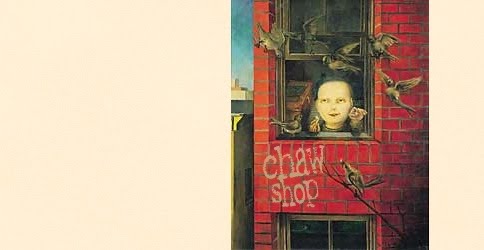
Black Hole tells the story of a group of teenagers in the 1970's, beset with a mysterious STD that turns them into freaks: a girl sheds her skin, a boy develops a tiny talking mouth on his neck, and others contract maladies even more difficult to encapsulate in words. This is pulpy, suspenseful, and compelling in itself, and if Burns relied on the bare bones of the story to carry us through, I'd probably still have kept turning the pages. However, what he does is a lot stranger.
When reading the book, I was at first inclined to think that the disease the teens suffer from is meant to represent something from our world, most likely AIDS. But by the end, I became convinced that Burns is not working metaphorically, using one set of images to stand in for another set that the reader can supply. Black Hole, instead, is about the hidden connections between images: the way an incision in a frog's belly or a cut on the sole of a foot looks like a vagina, the way a tail resembles a penis. And as the book goes on, far from becoming easier to parse, these connections multiply. Objects -- bones, pipes, sandwiches, snakes -- stream across the pages, freed from their original context; panels break out from their orderly grid. We're no longer decoding symbols. The meaning of the objects clearly can't be divorced from the particular way they're depicted.
This is something we're more inclined to accept in visual art than in narrative. Perhaps it's because of the way literature is taught: at least at the places I attended, most American schoolchildren grew up thinking that it was possible to figure out what a poem "really meant," what a story was "about," and articulate this without the work's meaning being lost, as if literature were simply a foreign language they were learning to speak. Stylistic embellishments stood as obstacles in the way to understanding, an odd regional accent that made the speaker's words tougher to translate. "What is Wallace Stevens trying to say here?" one high school teacher said of the poem "Anecdote of the Jar," facing a classroom of dead silence. He sighed, deciding to give us a break. "All right, I'll just tell you: it's about environmentalism."
Yet, with visual art, the work qua object is not so easily dispensed with. Words can describe a painting or sculpture, but even a nine-year-old knows they cannot replace it. And thus, even if the technical aspects of the artwork -- the perspective, the composition, the colors -- are perceived to be unpleasant or disagreeable, difficult, they're still treated as part of the thing we're seeing, rather than something that prevents us from seeing that thing clearly.
Perhaps, though, the popularity of graphic novels (at least sophisticated ones like Black Hole) can serve as a bridge between these opposed ways of seeing visual art and narrative. Wouldn't that be nice?
Showing posts with label freaks. Show all posts
Friday, September 24, 2010
Thursday, September 23, 2010
Send in the Clones
I am not a proponent of the faithful film adaptation. Many of my favorites (like Stanley Kubrick's Lolita or Terry Zwigoff's Ghostworld) veer wildly from their equally magnificent source material, and others (like Tim Burton's soul-consuming masterpiece Big Fish) actually improve upon the so-so books they tackle. To me, the important thing is not that a movie is true to the vision of the book upon which it's based; I only care that the movie is true to its own vision, that it creates, in its characters, settings, and story, something that takes advantage of the visual medium and creates a world unto itself.
However, when a film adaptation systematically skips over all of the incidents that made the novel original, poignant, and tenderly observed, when it drops out emotional complexity and internal conflict from its depictions of the characters, when it strips settings of their power and objects of their meaning, and when it neglects to replace any of these elements with anything, anything at all, besides horrible treacly predictable Hollywood schlock -- well, it's at those times that I wish I'd waited for the DVD. In his lovely and accomplished novel Never Let Me Go, Kazuo Ishiguro describes a landscape through the eyes of the main characters, who have just, for the first time, left the boarding school where they grew up. "We could see hills in the distance that reminded us of the ones in the distance at Hailsham, but they seemed to us oddly crooked, like when you draw a picture of a friend and it's almost right but not quite, and the face on the sheet gives you the creeps," he writes. Mark Romanek's mediocre film adaptation of this very novel gave me a similar feeling, except that instead of "the creeps," one could more accurately say "the intense desire to cram Junior Mints in my ears to muffle the awful score."
To be fair, the movie isn't all bad. Romanek used to be a music video director (he also did the spooky Robin Williams vehicle One-Hour Photo), and he's decent at creating the film's visual world, which alternates in mood between a scruffy-preppy teen fall fashions photoshoot and the chilly operating rooms of Cronenberg's Dead Ringers. And the actors are all right, although in the later parts of the film, the exaggerated naivete and perpetually open mouth of leading man Andrew Garfield made me wonder if maybe his brain was in fact his first organ donation.
But the real problem here is the screenplay, a despicably shallow and mechanistic interpretation of the irreducibly complex relationships evoked by the book. After a 10 PM showing last night, I actually went home and reread over a hundred pages of Never Let Me Go, just to make sure I wasn't crazy for having liked it in the first place. I wasn't. One of the things the book excels at, above all else, is revealing the thorny and delicate nature of lifelong female friendships. The main character, Kathy H., and her best friend Ruth are close from the age of six or seven on, but this closeness isn't static: they draw close and pull apart, again and again, in a kind of dance. Superficially, Ruth is charismatic and social, more "popular" than her quieter friend, and there are moments when she holds this over Kathy. Yet Ruth is also intensely needy and vulnerable, desperate to be loved. Kathy understands this about Ruth in a way that no one else seems to; her attunement to Ruth's often minute internal fluctuations of mood make her irreplacable, but also provide her ample opportunities to call Ruth out on minor pretensions and casual half-truths. Neither girl is perfect, but their friendship with each other is precious, the defining tie of their childhoods and early adult lives.
The famous "Bechdel Test," taken from the comic strip "Dykes to Watch Out For," was derived from a panel where a character states she only will watch a film if it satisfies the following three requirements: it has to have at least two women in it, who talk to each other, about something besides a man. I think treating these components as prequisites is misguided and limiting -- many terrific movies feature only male characters, or only a man and a woman, or only a single woman navigating a male-dominated environment. However, I do think that this rule speaks to something that is regrettable about the way that female interaction is often depicted onscreen.
Case in point: in the stupid, stupid screenplay for Never Let Me Go, Ruth and Kathy's entire relationship is reduced to their mutual attraction to Tommy, a boy from Hailsham. Kathy loves Tommy. Ruth steals Tommy. Ruth gives Tommy back. The film turns Ruth into an evil man-eater and Kathy into a pathetic, sniveling victim. In this scenario, there is no reason for the girls to be friends, nothing between them except for barely concealed hostility, resentment, and competition. Yet the movie, for some reason, expects that viewers will invest in the girls' connection with each other -- that when they reunite, after ten years of separation, we'll care. Huh?
Moreover, this set-up reduces Tommy to an object, a pawn, entirely and inexplicably under Ruth's control. It's clear he and Kathy are sweethearts from day one; as small children, they exchange loving glances with such irritating frequency, it's like they're auditioning for an episode of the Wonder Years. But when Ruth decides she wants him, he takes her hand without hesitation. If the movie chalked this up to the fact it's Keira freaking Knightley, I'd believe he was just under the spell of an intense sexual attraction. But instead, it's weirdly apparent that he takes no pleasure from their love affair -- he even covers his eyes while they get it on, I guess to think of Kathy. So why is he with Ruth at all? I guess because he's a pathetic, sniveling victim too. He and Kathy really are soulmates... that is, if they have souls at all. I have to say that, by the end of the picture, I still wasn't entirely convinced.
Never Let Me Go is a science fiction story in that it has a speculative premise: these characters are being raised to donate their internal organs as adults. But even in the novel, this premise is the weakest part. I never really found it believable that the majority of ordinary people would accept the practice of raising clone children just to slaughter them for their livers and kidneys. I can't imagine what kind of science would necessitate the creation of full-fledged human donors with personalities rather than organs grown independently, or harvested from insentient bodies cultivated in farms. Even the widespread passivity of the donors is tough to swallow -- although I believe it about the students from Hailsham, whose misplaced loyalty to their alma mater keeps them from entirely turning their backs on the purpose for which they were raised.
Yet though I do think these logistical problems mar the novel, Ishiguro manages to deflect attention from them by keeping the focus on the personal, the everyday: the shades of meaning in an off-handed comment, the inside jokes and odd slang, the awkward hedonism of the characters' one night stands and communal porno collections. (As a sidenote, I think it's interesting how much sex Hollywood removed from this story. In the book, donors are unable to conceive children and thus are encouraged to enjoy casual sex for pleasure, even as young teenagers -- Kathy herself sleeps around compulsively. In the film, of course, she's treated as a repressed and saintly virgin, while smokin' hot Ruth stalks around post-coitally in a short robe: yet another way their friendship is dumbed down to fit catfight cliches.)
In other words, Kathy, as the book's narrator, is not concerned with the big picture of the world in which she lives; she's interested in the particularities of the people and places who have meant the most to her in her life, and she evokes these characters and settings so skillfully, so effortlessly, that it's tough not to feel like you've known them yourself.
In the movie, though, there is no such veil of minutia to shield us from the plot's gaping holes and so, at the very moments when we're meant to feel, we find ourselves thinking instead: about how the hell all of this could come to pass, about when it's going to end. Fortunately for us, if not for the characters, it's all over sooner than you'd expect.
However, when a film adaptation systematically skips over all of the incidents that made the novel original, poignant, and tenderly observed, when it drops out emotional complexity and internal conflict from its depictions of the characters, when it strips settings of their power and objects of their meaning, and when it neglects to replace any of these elements with anything, anything at all, besides horrible treacly predictable Hollywood schlock -- well, it's at those times that I wish I'd waited for the DVD. In his lovely and accomplished novel Never Let Me Go, Kazuo Ishiguro describes a landscape through the eyes of the main characters, who have just, for the first time, left the boarding school where they grew up. "We could see hills in the distance that reminded us of the ones in the distance at Hailsham, but they seemed to us oddly crooked, like when you draw a picture of a friend and it's almost right but not quite, and the face on the sheet gives you the creeps," he writes. Mark Romanek's mediocre film adaptation of this very novel gave me a similar feeling, except that instead of "the creeps," one could more accurately say "the intense desire to cram Junior Mints in my ears to muffle the awful score."
Inside, I was screaming.
To be fair, the movie isn't all bad. Romanek used to be a music video director (he also did the spooky Robin Williams vehicle One-Hour Photo), and he's decent at creating the film's visual world, which alternates in mood between a scruffy-preppy teen fall fashions photoshoot and the chilly operating rooms of Cronenberg's Dead Ringers. And the actors are all right, although in the later parts of the film, the exaggerated naivete and perpetually open mouth of leading man Andrew Garfield made me wonder if maybe his brain was in fact his first organ donation.
But the real problem here is the screenplay, a despicably shallow and mechanistic interpretation of the irreducibly complex relationships evoked by the book. After a 10 PM showing last night, I actually went home and reread over a hundred pages of Never Let Me Go, just to make sure I wasn't crazy for having liked it in the first place. I wasn't. One of the things the book excels at, above all else, is revealing the thorny and delicate nature of lifelong female friendships. The main character, Kathy H., and her best friend Ruth are close from the age of six or seven on, but this closeness isn't static: they draw close and pull apart, again and again, in a kind of dance. Superficially, Ruth is charismatic and social, more "popular" than her quieter friend, and there are moments when she holds this over Kathy. Yet Ruth is also intensely needy and vulnerable, desperate to be loved. Kathy understands this about Ruth in a way that no one else seems to; her attunement to Ruth's often minute internal fluctuations of mood make her irreplacable, but also provide her ample opportunities to call Ruth out on minor pretensions and casual half-truths. Neither girl is perfect, but their friendship with each other is precious, the defining tie of their childhoods and early adult lives.
The famous "Bechdel Test," taken from the comic strip "Dykes to Watch Out For," was derived from a panel where a character states she only will watch a film if it satisfies the following three requirements: it has to have at least two women in it, who talk to each other, about something besides a man. I think treating these components as prequisites is misguided and limiting -- many terrific movies feature only male characters, or only a man and a woman, or only a single woman navigating a male-dominated environment. However, I do think that this rule speaks to something that is regrettable about the way that female interaction is often depicted onscreen.
Case in point: in the stupid, stupid screenplay for Never Let Me Go, Ruth and Kathy's entire relationship is reduced to their mutual attraction to Tommy, a boy from Hailsham. Kathy loves Tommy. Ruth steals Tommy. Ruth gives Tommy back. The film turns Ruth into an evil man-eater and Kathy into a pathetic, sniveling victim. In this scenario, there is no reason for the girls to be friends, nothing between them except for barely concealed hostility, resentment, and competition. Yet the movie, for some reason, expects that viewers will invest in the girls' connection with each other -- that when they reunite, after ten years of separation, we'll care. Huh?
Moreover, this set-up reduces Tommy to an object, a pawn, entirely and inexplicably under Ruth's control. It's clear he and Kathy are sweethearts from day one; as small children, they exchange loving glances with such irritating frequency, it's like they're auditioning for an episode of the Wonder Years. But when Ruth decides she wants him, he takes her hand without hesitation. If the movie chalked this up to the fact it's Keira freaking Knightley, I'd believe he was just under the spell of an intense sexual attraction. But instead, it's weirdly apparent that he takes no pleasure from their love affair -- he even covers his eyes while they get it on, I guess to think of Kathy. So why is he with Ruth at all? I guess because he's a pathetic, sniveling victim too. He and Kathy really are soulmates... that is, if they have souls at all. I have to say that, by the end of the picture, I still wasn't entirely convinced.
Never Let Me Go is a science fiction story in that it has a speculative premise: these characters are being raised to donate their internal organs as adults. But even in the novel, this premise is the weakest part. I never really found it believable that the majority of ordinary people would accept the practice of raising clone children just to slaughter them for their livers and kidneys. I can't imagine what kind of science would necessitate the creation of full-fledged human donors with personalities rather than organs grown independently, or harvested from insentient bodies cultivated in farms. Even the widespread passivity of the donors is tough to swallow -- although I believe it about the students from Hailsham, whose misplaced loyalty to their alma mater keeps them from entirely turning their backs on the purpose for which they were raised.
Yet though I do think these logistical problems mar the novel, Ishiguro manages to deflect attention from them by keeping the focus on the personal, the everyday: the shades of meaning in an off-handed comment, the inside jokes and odd slang, the awkward hedonism of the characters' one night stands and communal porno collections. (As a sidenote, I think it's interesting how much sex Hollywood removed from this story. In the book, donors are unable to conceive children and thus are encouraged to enjoy casual sex for pleasure, even as young teenagers -- Kathy herself sleeps around compulsively. In the film, of course, she's treated as a repressed and saintly virgin, while smokin' hot Ruth stalks around post-coitally in a short robe: yet another way their friendship is dumbed down to fit catfight cliches.)
In other words, Kathy, as the book's narrator, is not concerned with the big picture of the world in which she lives; she's interested in the particularities of the people and places who have meant the most to her in her life, and she evokes these characters and settings so skillfully, so effortlessly, that it's tough not to feel like you've known them yourself.
In the movie, though, there is no such veil of minutia to shield us from the plot's gaping holes and so, at the very moments when we're meant to feel, we find ourselves thinking instead: about how the hell all of this could come to pass, about when it's going to end. Fortunately for us, if not for the characters, it's all over sooner than you'd expect.
Wednesday, August 11, 2010
Larger Than Life
The Errol Morris television show “First Person” boasted the memorable tagline, “Spend some time in another person’s mind.” That statement was absolutely true for the program, which revealed the inner mental lives of a diverse assortment of individuals, including a giant squid-obsessed scientist, a neurotic former “Who Wants to be a Millionaire” contestant, and a babe who dates only convicted serial killers. But it’s also true of first person as a point of view for a work of fiction, at its best. Most readers of contemporary fiction are familiar with the device of the unreliable narrator. I'd argue that, in fact, the appeal of any first person narrator lies to some extent in his unreliability, his elisions and generalizations, the limits of his diction and the colors that particular desires and fears paint his reality. The setting isn't just a physical place, but the inside of someone's head. In a first person story, the meaning of the narrative is doubled: we wonder not just what will happen next, but why the speaker feels compelled to tell us about it – what he’s getting at.
Now don't get me wrong. The idea of a gigantic dying narrator who views her world through the narcotizing haze of sentimentality is actually, to me, incredibly compelling, even heartbreaking. I love the idea that Truly’s isolation, her circumscribed experience, her lack of book-learning and intellectual curiosity (“Me, I’ve never been a big reader. I figure that if a secret has an answer it’ll out on its own if it’s meant to”) might limit her perspective so much that, like the long-suffering butler in Ishiguro’s Remains of the Day, she finds herself unable to see what’s right in front of her face in her community and in the lives of people around her. It would be tragic if she considered her sister a beautiful princess, for example, the jewel of the town, whose prized virginity was snatched by a dastardly usurper, when in fact her sister was an attractive but average girl whose high school boyfriend knocked her up; if she saw her teacher (named, I shit you not, Priscilla “Prissy” Sparrrow) as a lonely, desperate spinster as a way of projecting her own teenage sexual frustration onto a nearby target; if she imagined the cruel, manipulative Morgans ruled the town and everyone in it with sneaky maneuvers and outright strong-arming, when in fact their only advantages were the typical ones allotted to the wealthier and better educated members of any American community. Misperceptions of this kind wouldn’t just lend poignancy to the otherwise irritating down-home voice; they would help to explain why Truly remains so inexplicably passive, kowtowing to authority figures and viewing herself as a victim for most of her life rather than actively shaping her destiny. Bloated with a diet of half-digested Frank Capra storylines and rural truisms, Truly could have been the best kind of unreliable narrator: the kind whose exaggerations and contradictions reveal larger, more disturbing truths about the culture from which she springs.
First person draws greater attention to this question, I think, at the moments when it oversteps its traditional boundaries: when a narrator relates scenes or incidents for which he could not possibly have been present. This can be a masterful move. As I noted in an earlier post, one of the only good things about Eugenides’s sloppy, emotionally dishonest behemoth Middlesex was the confident way the speaker reached generations back to lead up to the inciting incident of her/his own birth. And the shimmering architecture of Lethem’s Chronic City is dotted with several open windows, moments when narrator Chase Insteadmen’s tender observations of his friends allow him, for a moment, to actually step outside himself to inhabit their twitchy, itchy, off-balance selves. But these moments are stunning not by accident but necessity. When an author breaks all the rules, there needs to be a payoff, something that makes the gesture a revelation rather than simply a mistake.
This is all a long way of leading into the point of today’s blog post, which is that Tiffany Baker's The Little Giant of Aberdeen County is the worst book I’ve read all summer – the sort of thing airport screeners should forcibly remove from luggage, along with combustible liquids, loaded revolvers, Ebola monkeys, and any other items known for ruining vacations. And, in my opinion, the first of its many faults is its blatant misuse of the aforementioned device. In the book, the title character not only steps out of her own subjectivity to narrate scenes for which she couldn’t have possibly been present; she does it to the detriment of the story’s world and the development of the other characters.
Her narration overshadows everything else.
The Little Giant of Aberdeen County tells the story of one Truly Plaice, a genetic anomaly whose overactive pituitary starts her growth off at lightning speed and keeps her expanding exponentially long into adulthood. Her monstrous birth (along with a conveniently timed breast lump) destroys her mother, leaving Truly and her lovely, delicate sister Serena Jane in the hands first of their alcoholic father and, after he drinks himself to death, with appointed guardians in town: the Rev. Pickerton & fam for Serena Jane, the down-and-out, ramblin’ gamblin’ Dyersons for Truly. Serena Jane wants nothing more than to high-tail it out of ol’ Aberdeen to Hollywood , but shucks, fate has other plans in store for her. She’s date-raped by Bob Bob Morgan, the son of the town’s doctor, and, since in a novel like this a single ejaculation inevitably packs more dramatic punch than a heat-seeking missile, instantly becomes pregnant. She marries Bob Bob, bears a son, and then disappears, leaving Truly – for some convoluted and underexplained reasons – saddled with the twin burdens of keeping house for her pure-evil husband and raising her odd-duck child.
This is not a subtle book. This is the kind of painfully folksy yarn where the narrator’s philosophizing about euthanasia is explored through the metaphor of whether or not it’s right to shoot a horse with a broken neck (in case you’re wondering: “You go and get your shotgun and you shoot it right between the eyes, hard.”); where she comments on the differences between herself and her sister with faux-profundities like, “Pretty can’t exist without ugly”; where the daily life of a town is compressed into meaningless generalizations like, “We in Aberdeen are pure creatures of habit” and non sequiturs including, “One of the things you learn growing up in a small town where everyone knows everyone’s business is that desire is communal.” In telling the story of her life, Truly Plaice takes her own gigantism as a free pass to cast every individual around her, good or bad, as a character straight out of a fairy tale. Her sister is a “china doll,” with “Kewpie lips… black fringed eyes… flossy yellow hair.” Evil Bob Bob has “the semblance of a hairless wolf.” “Without her church face,” we learn, “Amanda Pickerton almost looked like a fox,” but down-at-the-heels country wife Brenda Dyerson is pretty when she stops kneading bread long enough to let it show. And the problems Truly describes all of them facing are hardly a full step removed from the old vaudeville parody of standard melodrama: “You must pay the rent!” “I can’t pay the rent!” “I’ll pay the rent!” “My hero!”
Now don't get me wrong. The idea of a gigantic dying narrator who views her world through the narcotizing haze of sentimentality is actually, to me, incredibly compelling, even heartbreaking. I love the idea that Truly’s isolation, her circumscribed experience, her lack of book-learning and intellectual curiosity (“Me, I’ve never been a big reader. I figure that if a secret has an answer it’ll out on its own if it’s meant to”) might limit her perspective so much that, like the long-suffering butler in Ishiguro’s Remains of the Day, she finds herself unable to see what’s right in front of her face in her community and in the lives of people around her. It would be tragic if she considered her sister a beautiful princess, for example, the jewel of the town, whose prized virginity was snatched by a dastardly usurper, when in fact her sister was an attractive but average girl whose high school boyfriend knocked her up; if she saw her teacher (named, I shit you not, Priscilla “Prissy” Sparrrow) as a lonely, desperate spinster as a way of projecting her own teenage sexual frustration onto a nearby target; if she imagined the cruel, manipulative Morgans ruled the town and everyone in it with sneaky maneuvers and outright strong-arming, when in fact their only advantages were the typical ones allotted to the wealthier and better educated members of any American community. Misperceptions of this kind wouldn’t just lend poignancy to the otherwise irritating down-home voice; they would help to explain why Truly remains so inexplicably passive, kowtowing to authority figures and viewing herself as a victim for most of her life rather than actively shaping her destiny. Bloated with a diet of half-digested Frank Capra storylines and rural truisms, Truly could have been the best kind of unreliable narrator: the kind whose exaggerations and contradictions reveal larger, more disturbing truths about the culture from which she springs.
But Baker leaves no room for us to question Truly’s version of events. Instead, she actually grants Truly greater authority by bestowing on her omniscience, allowing her to routinely relay information that she couldn’t possibly have access to. These moments are never bracketed with caveats – “I imagine” or “she later told me” – and they aren’t mere asides: they’re given to us in full scene, as if Truly were truly there.
Yet in these moments, the fact of Truly’s remove, her position as observer rather than participant, is also oddly emphasized. In one of the weirdest passages of the novel, she depicts the scene of her sister’s date rape, prefacing her description with this statement: “What can I say about the events that followed that evening between Bob Bob and my sister? Only that Serena Jane always wanted a starring role in something, and she finally got it… Thinking about all of this – even now – is like watching a movie for me. There’s the urge to scream at the person on the screen, to warn them, but of course, doing so only results in a sore throat and nasty looks from everyone else around you.” Highlighting herself as viewer – as voyeur – may seem bizarre, but it serves a purpose: it makes it more difficult for the reader to reject what follows as hearsay or supposition or outright fabrication. Truly can see what happened, frame by frame. She is a camera (here, that metaphor is explicit), and everyone knows that cameras don’t lie.
In this way, Baker is successful in discouraging the reader from approaching Truly’s narration critically. But the larger effect of this is to make the story’s world not more real, but less. We’re given no alternative to viewing the other players in this story the way Truly does, and thus the stereotypes she presents us with are externalized. The haughty princess, the calculating villain, the gentle gardener, the spinster schoolteacher are not timeworn paradigms a miserable woman employs to make sense of her frustrated, stifled existence; they’re the actual figures present in this town. And so, reading this book isn’t allowing us to spend some time in another person’s mind; it’s sentencing us to a prison term in a town built from the ground up of everyone’s clichés. No wonder so many people in this community come to Truly begging for death potions to help them finish themselves off peacefully. Once you realize you know everything that’s coming, it can be a chore to wait for the end.
Tuesday, December 1, 2009
Stuck in the Middle With You, pt. 2
"'The king died and then the queen died is a story. The king died and the queen died of grief is a plot." - EM Forster
Let me say, first off, that Middlesex is beautifully written, and that in it, Eugenides effortlessly creates an unforgettable world. I loved the descriptions of Detroit, before and after the race riots, and of the futuristic house on Middlesex, "a house that was more like communism, better in theory than reality" with its "long accordion-like barriers, made from sisal, that worked by a pneumatic pump located down in the basement" in the place of traditional doors. The Zebra Room restaurant and the hot dog stands and even the girl's bathroom in Callie's school are rendered with such care and specificity that it's almost impossible to believe they don't exist. And even individual scenes -- like the burning of the restaurant, or Callie and the Obscure Object's sleepovers -- come gorgeously, luminously, to life. But, for me at least, the whole of this book doesn't hang together. It is a story, in the sense that one event follows another in rapid succession, but it isn't a plot: the events bear no more relation to one another than fireworks shot off one after the other do.
After finishing the novel, I found this article from the New York Review of Books, which captured part of what I struggled with in it. Mendelsohn writes, "There's no way to prove it, but I have a feeling that Middlesex began its life as two novels: a Greek immigrant story, based to whatever extent (one hopes not too great) on the author's family history; and a novel about the alluring subject of bimorphic sexuality (based, perhaps, on the sensational case, much publicized a few years ago, of a Midwestern girl who turned out, like Callie, to be genetically male)... But the graft didn't take... There's no reason, whether in theme or meaning, that this hermaphrodite should be Greek, except that Eugenides makes her Greek, because he has a Greek story to tell as well as a hermaphrodite's story."
I wholeheartedly agree with this assessment. Although, as I mentioned before, we spend the first 200+ pages of the novel with Cal's parents and grandparents, the only link between their stories and his appears to be genetic. Though we're introduced to Cal through the lens of his family, his relationships with them are sketched in at best, nowhere near the emotional center of the book. An almost cartoonish example of this can be found on page 521, when, after literally hundreds of pages with no mention of the family matriarch, Cal writes, "Patient reader, you may have been wondering what happened to my grandmother. You may have noticed that, shortly after she climbed into bed forever, Desdemona began to fade away. But that was intentional. I allowed Desdemona to slip out of my narrative because, to be honest, in the dramatic years of my transformation, she slipped out of my attention most of the time." I'm glad Cal/Eugenides points out that this was intentional, because if he didn't, I might have thought it was really fucking sloppy. Fortunately, he has a good reason for dropping this central character from the narrative, even after spending chapter upon chapter on her love life and struggles in the New World: she slipped his mind. Nice save.
But it isn't just the schism between the Greek and hermaphrodite parts of the novel that bothers me. It's the schism between every single one of the book's many set pieces. For one example, Eugenides creates a character, Maxine Grossinger, for the sole purpose of having her die of an aneurysm, in order to throw Cal and his crush into one another's arms; Maxine's life and death are inconsequential compared to the resulting embrace, and the event is never returned to in any significant way: she's just gone. The focus then shifts to the relationship between Cal and "the Obscure Object," whose love for each other blossoms despite the stigma of what they believe to be their lesbianism. OK, so surely this thread won't completely drop out of the novel without explanation, right? Wrong again. After Cal gets hit by a car and rushed to the hospital, where the doctors discover his hermaphodism, one might expect to learn the consequences of this jarring news for the fledging love affair. Maybe the Object will be relieved. Maybe she will be disappointed, or scared, or angry. What's her reaction? We never know, because she never appears again in the novel. The last time we see her is before Cal even finds out what he is: "I lifted my head from the stretcher to gaze at the Object... For once more she was becoming a mystery to me. What ever happened to her? Where is she now?"
Good questions, all. A quick phone call could probably answer most of them, but that's not something Cal ever considers doing. I guess long distance was more expensive in those days.
Cal's father's death, probably the low point of the novel, also happens in a void: in a needlessly complicated sequence, a minor character convinces Cal's father that someone is holding runaway Cal for ransom. He delivers the money, but in the ensuing high-speed chase, his car goes off a bridge and he dies. One might expect some significant emotional consequences for Cal, especially since this death could have been prevented if Cal hadn't run away, or if he had just gotten back in touch with his family to let them know he was all right.
But instead, his reaction is this: "Most important, Milton [Cal's father] got out without ever seeing me again. That would not have been easy. I like to think my father's love for me was strong enough that he could have accepted me. But in some ways it's better that we never had to work that out, he and I. With respect to my father, I will always remain a girl. There's a kind of purity in that, the purity of childhood." Huh? That's basically the same logic as, "Mom and Dad, I'm gay. And now that I've told you, I'm going to have to kill you." Cal's supposed to be a hermaphrodite, not a sociopath – how could such a major emotional event be resolved for him as some kind of brow-wiping happy coincidence, all in a single paragraph?
In the climatic scene when Cal's hermaphrodism is revealed, Eugenides writes, "Chekhov was right. If there's a gun on the wall, it's got to go off. In real life, however, you never know where the gun is hanging. The gun my father kept under his pillow never fired a shot. The rifle over the Object's mantle never did either. But in the emergency room things were different... my body had lived up to its narrative requirements." But whose narrative requirements are those? Certainly not mine. For me, it's not enough for a character to lose his virginity, or die violently, or lose a fortune, or turn out to have X-Y chromosomes. If those things happen, they still have to matter: they have to have consequences, they have to come back. When they don't, we're left stuck in the middle of nowhere.
Let me say, first off, that Middlesex is beautifully written, and that in it, Eugenides effortlessly creates an unforgettable world. I loved the descriptions of Detroit, before and after the race riots, and of the futuristic house on Middlesex, "a house that was more like communism, better in theory than reality" with its "long accordion-like barriers, made from sisal, that worked by a pneumatic pump located down in the basement" in the place of traditional doors. The Zebra Room restaurant and the hot dog stands and even the girl's bathroom in Callie's school are rendered with such care and specificity that it's almost impossible to believe they don't exist. And even individual scenes -- like the burning of the restaurant, or Callie and the Obscure Object's sleepovers -- come gorgeously, luminously, to life. But, for me at least, the whole of this book doesn't hang together. It is a story, in the sense that one event follows another in rapid succession, but it isn't a plot: the events bear no more relation to one another than fireworks shot off one after the other do.
After finishing the novel, I found this article from the New York Review of Books, which captured part of what I struggled with in it. Mendelsohn writes, "There's no way to prove it, but I have a feeling that Middlesex began its life as two novels: a Greek immigrant story, based to whatever extent (one hopes not too great) on the author's family history; and a novel about the alluring subject of bimorphic sexuality (based, perhaps, on the sensational case, much publicized a few years ago, of a Midwestern girl who turned out, like Callie, to be genetically male)... But the graft didn't take... There's no reason, whether in theme or meaning, that this hermaphrodite should be Greek, except that Eugenides makes her Greek, because he has a Greek story to tell as well as a hermaphrodite's story."
I wholeheartedly agree with this assessment. Although, as I mentioned before, we spend the first 200+ pages of the novel with Cal's parents and grandparents, the only link between their stories and his appears to be genetic. Though we're introduced to Cal through the lens of his family, his relationships with them are sketched in at best, nowhere near the emotional center of the book. An almost cartoonish example of this can be found on page 521, when, after literally hundreds of pages with no mention of the family matriarch, Cal writes, "Patient reader, you may have been wondering what happened to my grandmother. You may have noticed that, shortly after she climbed into bed forever, Desdemona began to fade away. But that was intentional. I allowed Desdemona to slip out of my narrative because, to be honest, in the dramatic years of my transformation, she slipped out of my attention most of the time." I'm glad Cal/Eugenides points out that this was intentional, because if he didn't, I might have thought it was really fucking sloppy. Fortunately, he has a good reason for dropping this central character from the narrative, even after spending chapter upon chapter on her love life and struggles in the New World: she slipped his mind. Nice save.
But it isn't just the schism between the Greek and hermaphrodite parts of the novel that bothers me. It's the schism between every single one of the book's many set pieces. For one example, Eugenides creates a character, Maxine Grossinger, for the sole purpose of having her die of an aneurysm, in order to throw Cal and his crush into one another's arms; Maxine's life and death are inconsequential compared to the resulting embrace, and the event is never returned to in any significant way: she's just gone. The focus then shifts to the relationship between Cal and "the Obscure Object," whose love for each other blossoms despite the stigma of what they believe to be their lesbianism. OK, so surely this thread won't completely drop out of the novel without explanation, right? Wrong again. After Cal gets hit by a car and rushed to the hospital, where the doctors discover his hermaphodism, one might expect to learn the consequences of this jarring news for the fledging love affair. Maybe the Object will be relieved. Maybe she will be disappointed, or scared, or angry. What's her reaction? We never know, because she never appears again in the novel. The last time we see her is before Cal even finds out what he is: "I lifted my head from the stretcher to gaze at the Object... For once more she was becoming a mystery to me. What ever happened to her? Where is she now?"
Good questions, all. A quick phone call could probably answer most of them, but that's not something Cal ever considers doing. I guess long distance was more expensive in those days.
Cal's father's death, probably the low point of the novel, also happens in a void: in a needlessly complicated sequence, a minor character convinces Cal's father that someone is holding runaway Cal for ransom. He delivers the money, but in the ensuing high-speed chase, his car goes off a bridge and he dies. One might expect some significant emotional consequences for Cal, especially since this death could have been prevented if Cal hadn't run away, or if he had just gotten back in touch with his family to let them know he was all right.
But instead, his reaction is this: "Most important, Milton [Cal's father] got out without ever seeing me again. That would not have been easy. I like to think my father's love for me was strong enough that he could have accepted me. But in some ways it's better that we never had to work that out, he and I. With respect to my father, I will always remain a girl. There's a kind of purity in that, the purity of childhood." Huh? That's basically the same logic as, "Mom and Dad, I'm gay. And now that I've told you, I'm going to have to kill you." Cal's supposed to be a hermaphrodite, not a sociopath – how could such a major emotional event be resolved for him as some kind of brow-wiping happy coincidence, all in a single paragraph?
In the climatic scene when Cal's hermaphrodism is revealed, Eugenides writes, "Chekhov was right. If there's a gun on the wall, it's got to go off. In real life, however, you never know where the gun is hanging. The gun my father kept under his pillow never fired a shot. The rifle over the Object's mantle never did either. But in the emergency room things were different... my body had lived up to its narrative requirements." But whose narrative requirements are those? Certainly not mine. For me, it's not enough for a character to lose his virginity, or die violently, or lose a fortune, or turn out to have X-Y chromosomes. If those things happen, they still have to matter: they have to have consequences, they have to come back. When they don't, we're left stuck in the middle of nowhere.
Thursday, November 19, 2009
Stuck in the Middle with You, pt. 1
Right now I'm reading Middlesex by Jeffrey Eugenides. I'm not even halfway done with it, so this doesn't constitute a review, but it has gotten me thinking about storytelling. As with The Virgin Suicides, Eugenides goes way out on a limb with his choice of narrator, and, as with The Virgin Suicides, it somehow improbably works.
The first 200+ pages of Middlesex take place before the birth of the narrator, Calliope/Cal, who, we learn almost immediately, is a true hermaphrodite, born apparently female but now living adult life as a man (albeit with ambiguous genitalia). The first chapter concerns his (I'm going to use male pronouns for the sake of simplicity) conception and birth, but then we backpedal wildly, back to the youth of Cal's grandparents, who were brother and sister, and whose incest resulted in his gender-bending gene. It's a bizarre move, and actually made me set the book aside the first time I set out to read it: it's sort of like sitting down to watch Transamerica, only to have someone immediately change the channel to My Deeply Disturbing Incestuous Greek Wedding. It's not that I'm uninterested in Greece or, for that matter, hot brother-on-sister action, but it was completely different than what I expected.
But this time, I found myself fascinated. The perspective of a narrator who sees every event in his family's history as leading up to his own birth renders the world with a kind of megalomaniacal gloss, especially because, as he sometimes acknowledges but more often ignores, there's no way he could have access to the kind of information he's sharing about the sex lives and secrets of his parents and grandparents. This is not an unheard-of technique – in fact, Lethem does it from time to time in Chronic City – but doing it to the exclusion of anything else for hundreds of pages creates a really strange effect. Although we've spent hundreds of pages with this character, we've barely seen him interact with another human being, let alone reveal his character through choices of any consequence. But, if character is action, then why do we feel we know this guy so well? Our relationship with this narrator is less like our relationship to a character in fiction, and more like our relationship to an author, who reveals himself slowly through his allusions, vocabulary, and occasional personal asides.
The only comparison to Middlesex I can think of is with the television show "The Wonder Years," which is narrated by an unseen adult voice who repeatedly reminds the viewers that they're watching scenes from his childhood. That show was decidedly odd, because although the whole world of the episodes was cast in a nostalgic glow, you didn't know the present-day context for the memories; the narrator was both familiar (you knew his voice and the kinds of things he'd say) and unfamiliar (you couldn't picture his face). But even that isn't as strange as this, because the narrator is still a character in the show – he's just a child. Middlesex is like a version of "The Wonder Years" directed by Spike Jonze, where the narrative follows the events of Fred Savage's parents' lives as reconstructed in Fred Savage's mind. Also, there are silkworms.
I'm looking forward to reading the rest.
The first 200+ pages of Middlesex take place before the birth of the narrator, Calliope/Cal, who, we learn almost immediately, is a true hermaphrodite, born apparently female but now living adult life as a man (albeit with ambiguous genitalia). The first chapter concerns his (I'm going to use male pronouns for the sake of simplicity) conception and birth, but then we backpedal wildly, back to the youth of Cal's grandparents, who were brother and sister, and whose incest resulted in his gender-bending gene. It's a bizarre move, and actually made me set the book aside the first time I set out to read it: it's sort of like sitting down to watch Transamerica, only to have someone immediately change the channel to My Deeply Disturbing Incestuous Greek Wedding. It's not that I'm uninterested in Greece or, for that matter, hot brother-on-sister action, but it was completely different than what I expected.
But this time, I found myself fascinated. The perspective of a narrator who sees every event in his family's history as leading up to his own birth renders the world with a kind of megalomaniacal gloss, especially because, as he sometimes acknowledges but more often ignores, there's no way he could have access to the kind of information he's sharing about the sex lives and secrets of his parents and grandparents. This is not an unheard-of technique – in fact, Lethem does it from time to time in Chronic City – but doing it to the exclusion of anything else for hundreds of pages creates a really strange effect. Although we've spent hundreds of pages with this character, we've barely seen him interact with another human being, let alone reveal his character through choices of any consequence. But, if character is action, then why do we feel we know this guy so well? Our relationship with this narrator is less like our relationship to a character in fiction, and more like our relationship to an author, who reveals himself slowly through his allusions, vocabulary, and occasional personal asides.
The only comparison to Middlesex I can think of is with the television show "The Wonder Years," which is narrated by an unseen adult voice who repeatedly reminds the viewers that they're watching scenes from his childhood. That show was decidedly odd, because although the whole world of the episodes was cast in a nostalgic glow, you didn't know the present-day context for the memories; the narrator was both familiar (you knew his voice and the kinds of things he'd say) and unfamiliar (you couldn't picture his face). But even that isn't as strange as this, because the narrator is still a character in the show – he's just a child. Middlesex is like a version of "The Wonder Years" directed by Spike Jonze, where the narrative follows the events of Fred Savage's parents' lives as reconstructed in Fred Savage's mind. Also, there are silkworms.
I'm looking forward to reading the rest.
Subscribe to:
Posts (Atom)


