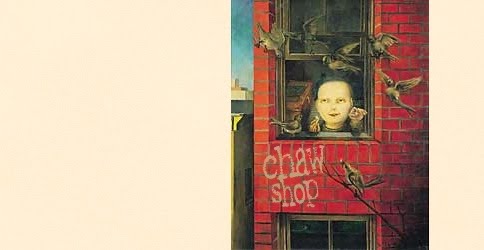
Obviously, as my second grade teacher explained to me then and as I am well aware now, personified animals or even inanimate objects (from Toy Story's Woody to Asimov's robots to Pynchon's Byron the Bulb) can just as easily function as the protagonists and antagonists in fiction as actual living humans can, and many great stories, especially for kids, feature relationships between humans and non-humans front and center. In stories of this kind, the enchanted creatures become the child's imagination externalized, made flesh, and tend to either mirror the child's thoughts about the adult world (Alice in Wonderland, The Phantom Tollbooth), provide fantastical tests for real-life moral quandaries (The Chronicles of Narnia, the film The Labyrinth), give the child the opportunity to reverse roles and take on the duties of protector or parent (The Indian in the Cupboard, the films The Iron Giant or ET), or supply reliable friendship and comfort while allowing the child to explore his identity outside of the confines of family (Winnie the Pooh, the comic strip Calvin and Hobbes). In all of these cases, though the creatures themselves certainly have independent goals and motivations, we see them through the child's eyes, and ultimately, we judge them in terms of the effect they have on the child in question. As much as a reader may like a talking faun or a lovable robot, it's clear she's not meant to locate herself in those characters. By definition, they are the Other.

We're aware that we see this character through the child-character's eyes.
For that reason, something odd tends to happen in stories where people and their civilization are conspicuously absent: we are forced to identify with someone inherently dissimilar to ourselves. As a kid, my first exposure to stories of this kind was in Aesop's fables. Interactions between a fox and a raven or a cat and the mice it pursues were unsettling, not just because of the unmitigated cruelty and violence (no second chances here), but because these animals, unmoored from the context of my world, were deeply unpredictable to me. One story in particular, the fable of the scorpion and the frog, was especially creepy: a scorpion hitches a ride on a frog's back to cross a fast-flowing river. The frog is uncertain if it should trust the scorpion not to sting it, but as the scorpion points out, if it stings the frog mid-journey, they will both sink and drown. Still, in the middle of the river, the scorpion stings his companion anyway. Why? "It's in my nature."
One of the big complicatons in stories entirely about animals comes with personifying more than one species of animal at a time. I call this the Animal Farm effect. In the novel Animal Farm by George Orwell (which does, in fact, briefly feature humans as well, though not in the same way as the kids' stories I described above), a mass revolt against an unjust farmer leaves the animals in charge. Yet, over the course of the story, the pigs -- originally placed in a management role because they are the smartest of the animals -- take on more and more of the qualities of humans in their interactions with the other barnyard creatures, until finally they are living almost exactly as their human masters once did, inhabiting the farmhouse and walking on two legs while others serve them. The rules of the farm, which once represented the interests of all, are now reduced to one simple credo: ALL ANIMALS ARE EQUAL, BUT SOME ARE MORE EQUAL THAN OTHERS.
Orwell, who was using the story to make a statement about Stalinist Russia, clearly meant for us to reject this maxim: the barnyard animals are all sentient, all capable of speech, and thus all equal on the novel's terms. But I think that "all animals are equal, but some are more equal than others" does reflect something that's frequently true about the use of animals in fiction. When creating a world dominated by animals, something must still be regarded as the Other in order for the animals' social order to be comprehensible to us -- in order for their life to at all resemble the relationship of human society to the natural world. Even in Animal Farm, rats, songbirds, and rabbits play this role: the other animals attempt to "tame" them (signalling to the reader that "tameness" is the "humanity" of animals in this scenario) but without success.
The mid-90's Disney film The Lion King, for all its many embarrassing faults (if I never hear the saccharine song "Hakuna Matata" again, it will be too soon), succeeds in this one respect, at least. With the exception of a meerkat, a wild boar, and a toucan -- all of whom are treated basically as servants and comic relief -- all of the speaking characters are predators, and the prey are basically de-personified. In one memorable scene, a herd of bison trample a lion to death, not out of anger or a desire for revenge, but because they literally cannot be reasoned with. They are running out of blind, unarticulated animal fear, seemingly unable to understand or even hear the cries of the main character for help. For some lions to be "good" and some "evil," for the choices of a lion to have any moral weight, we must first establish that the central nature of a lion qua predator is morally neutral. And we must do that by making it clear that the story is told from a lion's perspective.
I got to thinking about all these issues over the weekend, after seeing Zack Snyder's fun, gorgeous, and intermittently disappointing kids' feature, Legend of the Guardians: The Owls of Ga'hoole. After Watchmen (particularly the magnificent, absurdly ambitious, aggressively postmodern ultimate cut version, which I wrote about here, here, and here), I doubted he was going to top himself with a picture about magic talking owls, and unfortunately I was right. However, moments of this picture are still fucking glorious, beginning with a sequence at the beginning when an owl swoops down to snatch a mouse off a branch and then continues effortlessly in its flight. There are a few ornithological non-sequiturs throughout (one plot thread asserts that owlets can be turned to zombies by being forced to stare at the moon as they doze off -- a weird idea, considering that the laws of nature and even the film itself firmly establish that the little dudes are nocturnal), and a feel-good musical montage that made the Lion King soundtrack seem as edgy and smart as Sweeney Todd's in comparison. But the movie's best moments come when we see owls' own natural behaviors unexpectedly invested with emotional import.
"Branching," when owlets glide from branch to branch while learning to fly, is a little like athletics, a little like driving lessons, yet not exactly like either: it occupies a space in an owl's life not quite equivalent to anything in ours. And an even better scene (easily my favorite moment in the film), comes when the little sister of the two main owlets hawks up her first owl pellet, a solidified mass of mouse bones and fur that resembles something fossilized. Panting and traumatized, spittle dripping from her beak, she stares in horror at the thing her body has just unwittingly ejected, while her nursemaid, a dippy snake, bustles around saying things like, "Oh, it's a beautiful day, the day of your first pellet!" "You mean," the stunned chick replies, voice quaking with trepidation, "it's going to happen again?" Vomiting up an owl pellet is a little like menstruation is to humans, yet it also happens to boys; it's a bit like losing a tooth, but it never stops, not even in adulthood. At heart, it's a thing that happens only to owls, and it isn't transformed to parallel directly with human experiences -- but the way they respond to it, socially and personally, seems more or less the way people would, if people were owls.

Sure, they look real cute... until you see the gunk that comes out of their mouths.
In this sense, stories about animals or other non-human characters can be deeply subversive, and not just because they allow the author to veil controversial opinions under the guise of fantasy. Rather, these stories are subversive because of the way they allow readers or viewers to set aside their own perspective to emphathize with one that, by its very nature, is profoundly foreign, even disturbing or grotesque. Especially for kids, but really for all of us, that's a lesson that can't come soon enough.

